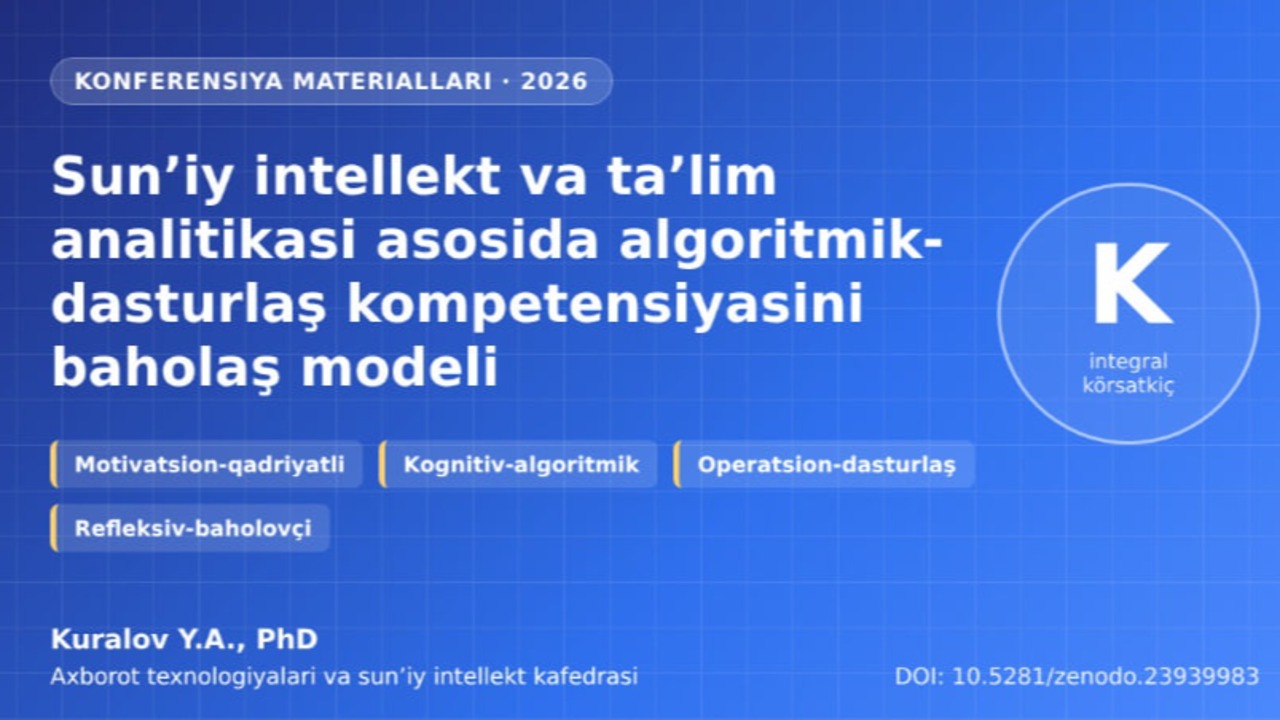
On 28–29 October 2026, the Department of Intelligent Sciences and Information Technologies of Namangan State Pedagogical Institute held the national scientific and practical conference “Digital-pedagogical transformation and research models of modern education”. The conference proceedings include a paper by Yuldash Kuralov, PhD, Head of the Department of Information Technologies and Artificial Intelligence, on assessing the algorithmic-programming competence of future computer science teachers.
The problem
Traditional assessment — tests, written work and final projects — records only the final result and shows little about how a student arrived at it. With AI tools now widely available, this gap has become even more noticeable.
The proposed model
The model assesses four components of the competence, each with its own indicators and data sources:
- Motivational-value component — the share of optional tasks completed, regular activity on the learning platform and compliance with the rules for using AI (platform logs and a questionnaire).
- Cognitive-algorithmic component — decomposing a problem, building an algorithm as a flowchart or pseudocode, and the number of hints taken from an AI assistant.
- Operational-programming component — the share of test cases passed, the number of attempts needed to fix errors, and code quality (automated testing and static code analysis).
- Reflective-evaluative component — the ability to find errors in AI-generated code and the substance of reflective writing (scored with a rubric by both AI and the teacher).
Data come from the student’s “digital footprint”: attempts, errors, help requests and time spent on the platform. Each component score is normalized to the range 0–1, and the overall integral index K is a weighted sum whose weights are set by expert evaluation. Four levels are defined: beginning (K < 0.50), satisfactory (0.50–0.70), high (0.70–0.85) and creative (K ≥ 0.85). These thresholds are a preliminary proposal to be refined through experimental testing.
The role of AI
The model does not ban AI; instead, how a student uses it becomes part of the assessment: the fewer hints a student needs from the AI assistant to reach a correct solution, the higher their cognitive-algorithmic score. Assessment runs in four stages — data collection, AI-assisted analysis, interpretation by the teacher, and personalized feedback. The key principle: AI automates the evaluation, while the teacher makes the final pedagogical decision.
Pedagogical and ethical conditions
Drawing on UNESCO guidance on generative AI in education, the paper sets out these conditions: assessment criteria are announced to students in advance; AI-generated grades are not final and must be confirmed by the teacher; students have the right to appeal; personal data are used only for educational purposes and are protected; and AI grades are periodically compared with teacher grades to check their reliability.
Conclusions
The model shifts assessment from the final result to the learning process, covers all components of the competence and turns AI use into a controlled pedagogical tool. Universities are advised to add process indicators alongside final exams in programming courses, use modules that record students’ digital footprint, supplement automated tests with code-quality analysis, and include critical evaluation of AI-generated code in assessment. The model’s effectiveness will be tested in experimental work at pedagogical universities.
Source: Kuralov Y.A. Sun’iy intellekt va ta’lim analitikasi asosida bo‘lajak informatika o‘qituvchilarining algoritmik-dasturlash kompetensiyasini baholash modeli // Proceedings of the national scientific and practical conference “Raqamli-pedagogik transformatsiya va zamonaviy ta’limning tadqiqot modellari”. – Namangan, 2026. – P. 632–635. DOI: 10.5281/zenodo.23939983