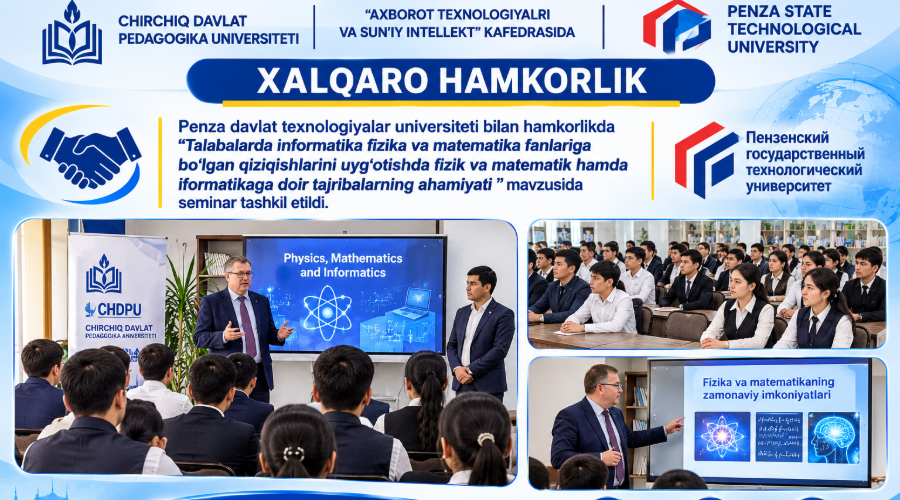
Department of Information Technologies and Artificial Intelligence
The Department of Information Technologies and Artificial Intelligence was established in 2025 on the basis of the Department of Methods of Teaching Informatics and the Department of Informatics and Information Technologies. The department teaches specialized courses for the bachelor programs “Information Systems and Technologies”, “Artificial Intelligence”, “Mathematics and Informatics”, “Mathematics” and “Applied Mathematics”, and for the master program “Information Technologies in Education”.
According to the staffing table, the department has 19 faculty members (20.5 staff positions), 8 of whom hold a PhD degree. Head of the department: Kuralov Yuldash Abdullayevich, PhD, Associate Professor.
Address: 104 Amir Temur Street, Chirchiq
E-mail: informatikaaxborot@gmail.com
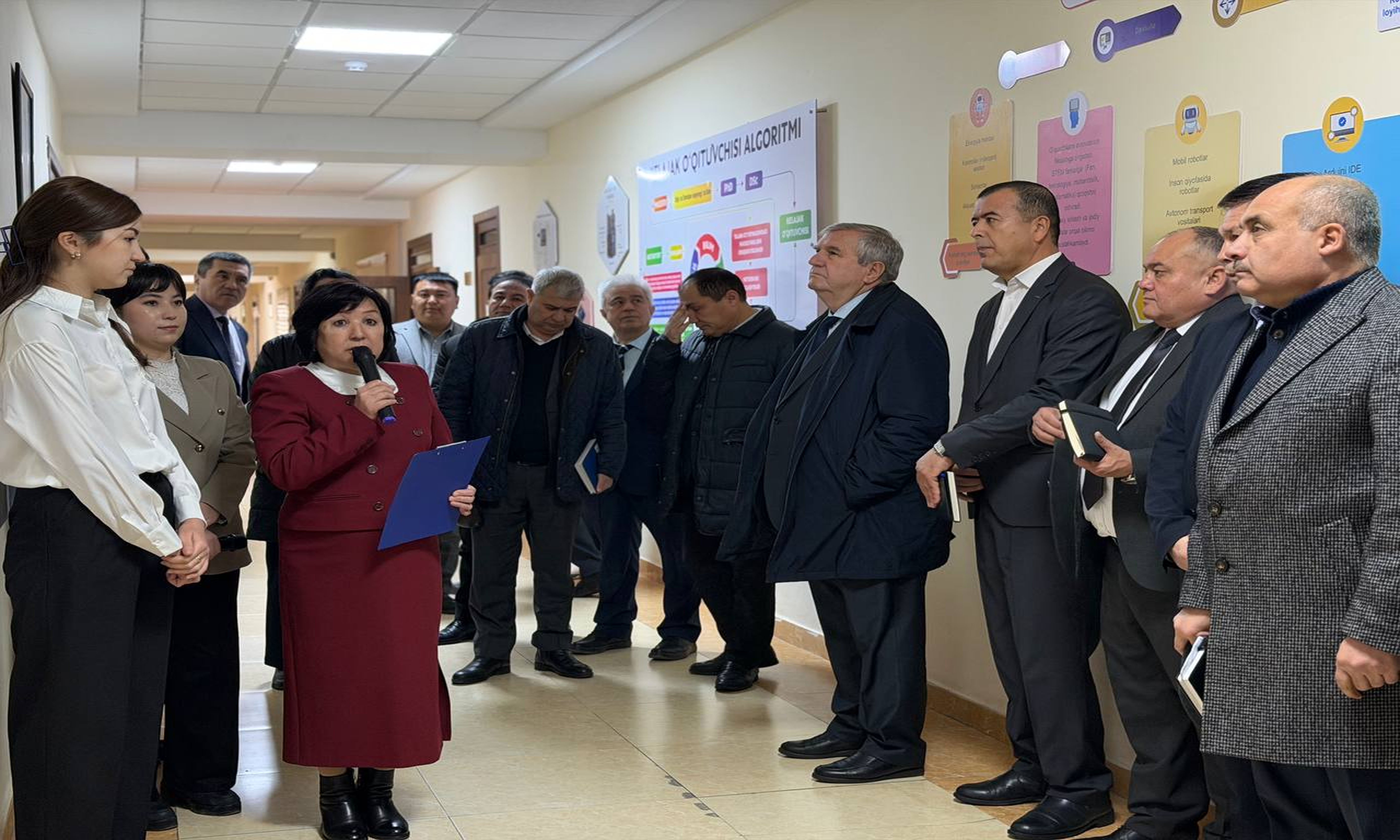
Exhibition within the framework of the “Educational Environment—Third Teacher” project
Within the framework of the “Educational Environment - Third Teacher” project organized at our university, the Department of Information Technologies and Artificial Intelligence carried out extensive practical work. Within the framework of the project, special attention was paid to organizing the educational environment in a modern, innovative and interactive form.
An exhibition and a holographic device were created at the entrance to the faculty on the theme “Physics + Mathematics + Information Technologies = Digital 3D Spatial Model - Hologram” based on the integration of disciplines. This work demonstrates the interrelationship and the practical application of digital technologies.
A demonstration tool called “Chain of Modern Literacy Competencies” was also created, reflecting the stages of development of the currently relevant field of artificial intelligence. As a logical continuation of this topic, an exhibition on the practical application of these technologies in the educational process was developed on the topic “Introducing artificial intelligence in education”.
An infographic exhibition entitled “Future Teacher Algorithm” was prepared within the framework of the “Future Teacher” project. At the same time, an exhibition dedicated to the life and scientific heritage of Al-Khwarizmi, the founder of the science of algorithms, was organized, and a video was developed based on artificial intelligence technologies, highlighting his rich scientific heritage and aimed at attracting students to science.
Taking into account that the main users of the educational environment are students, a number of visual aids were created on the specialized disciplines of the department:
An exhibition under the slogan “Robotics - Create! Program! Move!”, which contains the necessary information for studying the science of robotics;
“Modern Programming Languages” — an exhibition providing information about programming languages and basic programs popular among students;
“Computer Networks” — an exhibition providing information about network types, topology and technical devices;
“Web Programming” — an exhibition containing the necessary programs and basic concepts for becoming a web programmer.
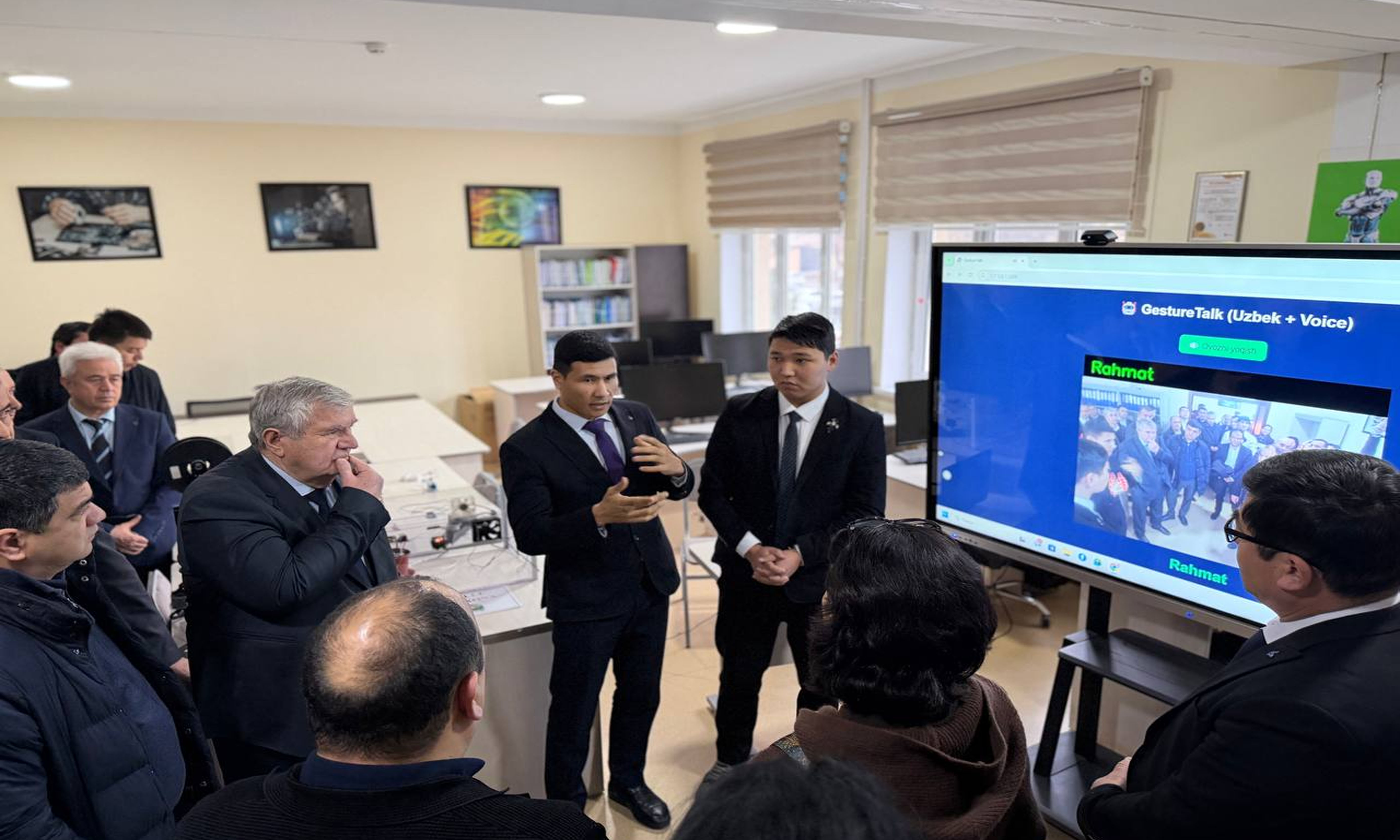
In addition, a virtual holographic teacher program and its device based on artificial intelligence were created for students. This innovative development allows for a more effective and interactive organization of the educational process.
A collection of certificates for software created by the professors and teachers of the department and a separate exhibition highlighting the activities of the department were also organized.
These works serve to enrich the educational environment, develop students' digital competencies, and establish effective education based on modern technologies.
 |
 |
International cooperation
Certain work is being carried out to further develop the international cooperation of the Department of "Information Technologies and Artificial Intelligence" and exchange experience with advanced foreign educational centers and organizations in the framework of educational, scientific and innovative research. Currently, the department has established cooperation with the following prestigious foreign higher educational institutions:
 Kazakh National Pedagogical University named after Abay |  Lublin University of Technology, located in Lublin, Republic of Poland |  South Kazakhstan State University named after Mukhtar Avezov |
International conferences and seminars
In accordance with the order of the Minister of Higher Education, Science and Innovations of the Republic of Uzbekistan No. 490 dated December 27, 2024, an international scientific and practical conference on the topic “New methods and innovations in the integration of mathematics and information technology disciplines” was held in Chirchik (Chirchik State Pedagogical University) on April 18-19, 2025.
Conference organizers
- Ministry of Higher Education, Science and Innovation
- South Kazakhstan University named after Mukhtar Auyezov
- Sultan Idris Pedagogical University
- Abay Kazakh National Pedagogical University
- Science & Innovation Journal
Chirchik State Pedagogical University
The conference will focus on the wide introduction of comprehensive and effective innovations in the integration of mathematics and information technology disciplines in the education system, improving the scientific level of teachers, improving the quality of education and educational infrastructure, existing problems and their solutions, studying international experience in this area, establishing partnerships, and the scientific basis of innovative ideas and developments of talented young people. Exchange of ideas among research experts through the application of innovative methods and technologies in the field that meet global requirements.
Department of Information Technologies and Artificial Intelligence
Chirchiq State Pedagogical University · Faculty of Exact Sciences
19 faculty members | 20.5 staff positions | 8 PhD holders | 16,480 teaching hours |
Head of the Department
Kuralov Yuldash Abdullayevich — Doctor of Philosophy (PhD) in Pedagogical Sciences, Associate Professor. Head of the department since 2026.
History
Chirchiq State Pedagogical University (formerly Chirchiq State Pedagogical Institute of Tashkent Region) was established by Resolution PQ-3152 of the President of the Republic of Uzbekistan dated 27 July 2017. The department grew out of the “Methods of Teaching Informatics” program within the Department of Exact Sciences of the Faculty of Exact and Natural Sciences.
By decision No. 1 of the Institute Council dated 28 August 2021, the Department of Informatics and Information Technologies was established within the Faculty of Mathematics and Informatics.
In 2025, the Department of Information Technologies and Artificial Intelligence was formed on the basis of the Department of Methods of Teaching Informatics and the Department of Informatics and Information Technologies. Today it is part of the Faculty of Exact Sciences.
Staff (according to the staffing table)
- Head of department — 1
- Associate professors — 3
- Acting associate professors — 2
- Senior lecturers — 7
- Lecturers — 6
- Staff positions: 20.5 (12 full-time, 8.5 internal part-time)
- Total teaching load: 16,480 hours, including 10,314 classroom hours
- PhD holders: Boymurodov A.Kh., Khurramov A.J., Kuralov Y.A., Yuldasheva G.T., Makhkamova M.U., Ibodullayev D.K., Rizayeva S.D., Urishov A.N.
Degree programs
- Bachelor: 60610100 – Information Systems and Technologies; 60610500 – Artificial Intelligence; Mathematics and Informatics; Mathematics; Applied Mathematics
- Master: 70610105 – Information Technologies in Education
Mission and objectives
- Teaching: educational, methodological and scientific-methodological work in specialized courses for bachelor and master students.
- Research: developing the department’s research area “Software support for individual learning programs within an educational cluster” and involving talented students in research.
- Training of researchers and teachers: preparing highly qualified specialists and educators.
- Educational and cultural work: fostering well-rounded personal development of students.
Growth of research capacity
Faculty composition and share of degree holders (last 3 academic years)
2024–2025
41.7%
research capacity
Total: 12
■ PhD holders: 5 (41.7 %)
■ Senior lecturers: 4 (33.3 %)
■ Lecturers: 3 (25.0 %)
2025–2026
25.0%
research capacity
Total: 16
■ PhD holders: 4 (25.0 %)
■ Senior lecturers: 7 (43.8 %)
■ Lecturers: 4 (25.0 %)
■ Acting assoc. prof. (no degree): 1 (6.3 %)
2026–2027
42.1%
research capacity
Total: 19
■ PhD holders: 8 (42.1 %)
■ Senior lecturers: 5 (26.3 %)
■ Lecturers: 6 (31.6 %)
Research capacity trend, %
41.7 %
25.0 %
42.1 %
Calculated by number of faculty members: 2024–2025 — department data; 2025–2026 and 2026–2027 — staffing tables of the respective years. Currently 8 PhD holders work at the department.
Contacts
Address: 104 Amir Temur Street, Chirchiq
E-mail: informatikaaxborot@gmail.com

Boymurodov Adham Xushimqulovich
Associate Professor of the Department
Doctor of Philosophy (PhD) in Pedagogical Sciences, Associate Professor





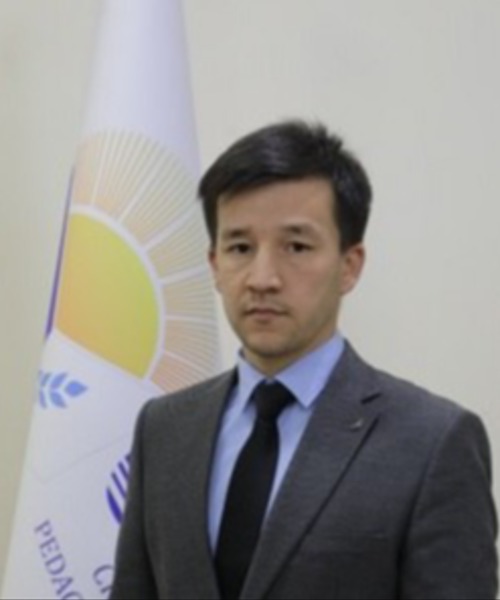


Kuralov Yuldash Abdullayevich
Axborot texnologiyalari va sun'iy intellekt kafedrasi mudiri
Doctor of Philosophy (PhD) in Pedagogical Sciences



Rizayeva Sanobar Davlataliyevna
Acting Associate Professor
Doctor of Philosophy in Educational Sciences (PhD)
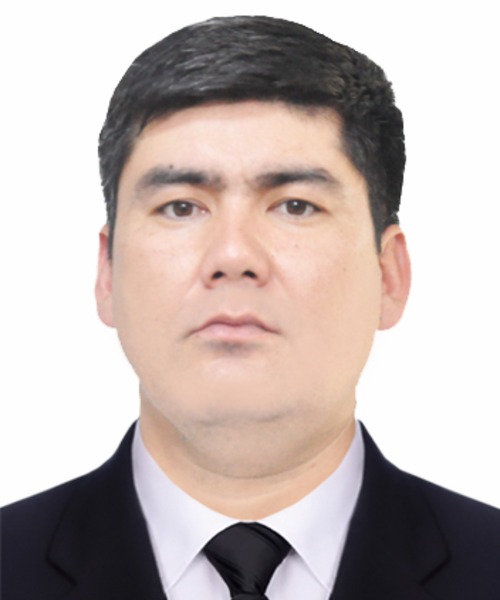

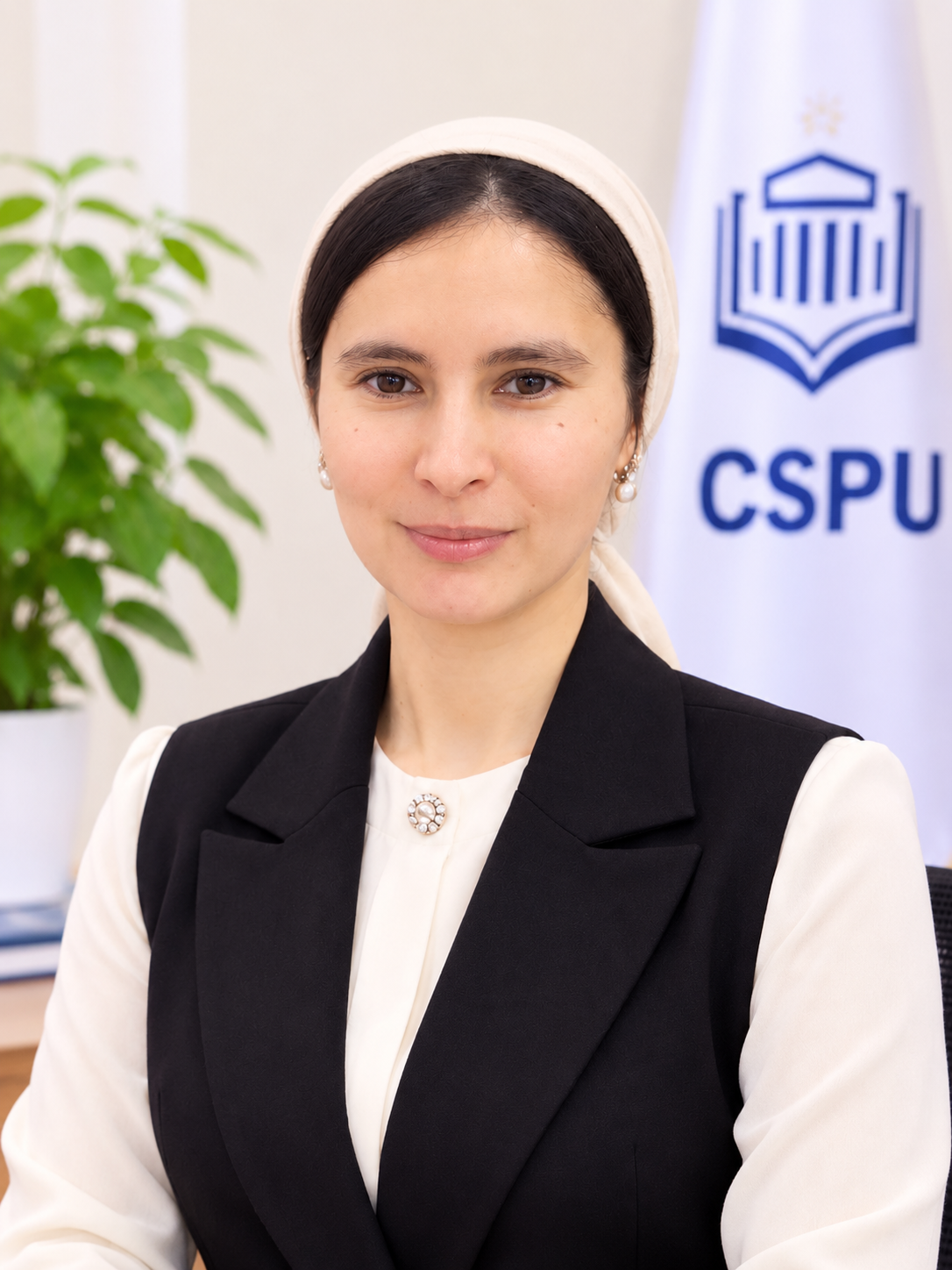
Nuraliyeva Raxima
O'qituvchi



Yuldasheva Gulshad Tileuovna
Head of the Department of Information Technologies and Artificial Intelligence
Doctor of Philosophy (PhD) in Pedagogical Sciences

Maxkamova Madina Ulfatjonovna
Kafedra Dotsenti
Educational activity
A learning process built on modern digital pedagogy and artificial intelligence technologies
16,480 total teaching hours | 10,314 classroom hours | 5 bachelor programs | 1 master program |
Organization of the learning process
- Lectures and practical classes in programming languages, databases, computer networks, artificial intelligence, machine learning and robotics.
- Wide use of digital learning resources, e-textbooks, video lessons and learning platforms.
- Curricula, syllabi, practical assignments and independent study tasks are developed and regularly updated.
Practical skills
- Practical classes in Python, C++, JavaScript, HTML/CSS, SQL, Django, FastAPI and other technologies.
- Laboratory work in AI systems, computer vision, natural language processing, neural networks, Big Data, IoT and cloud technologies.
- Preparing students for start-ups, hackathons, technology projects and innovation contests.
Assessment
- Current, midterm and final assessment through tests and practical assignments.
- Competences are assessed through case studies, projects, coding and building AI models.
| Grade | Criteria |
|---|---|
| 5 (excellent) | Draws conclusions and makes decisions, thinks creatively and independently, applies knowledge in practice, understands and can explain the essence. |
| 4 (good) | Distinguishes key concepts, reasons independently, applies knowledge in practice, understands and can explain the essence. |
| 3 (satisfactory) | Distinguishes tasks, understands the essence of concepts and has a general idea of the subject. |
| 2 (unsatisfactory) | Does not understand the task and has no clear idea of the subject. |
Research-oriented learning
- Involving students in research projects on AI, data analysis, robotics and cybersecurity.
- Organizing research clubs, seminars, master classes and scientific schools.
- Joint work with faculty on research papers, patents and start-up projects.
Internships and graduation projects
- Internships organized with IT companies, technology parks and incubators.
- Supervision of bachelor theses and master dissertations on IT-market-oriented topics.
- Project-based graduation work and a portfolio-oriented approach.
Improving the quality of education
- Introducing curricula aligned with modern IT and AI.
- Faculty development: Microsoft, Cisco, Google and Oracle certificates, international AI courses.
- Applying AI-based learning tools in teaching.
Individual work with students
- Mentoring, guidance of independent study, project teams.
- Career guidance, portfolio building and IT-market skills.
- Working with gifted students and preparing them for olympiads and contests.
Professional development
Faculty who completed professional development at the regional center under TSPU (Order No. 530 of the Minister of Higher and Secondary Specialized Education, 21 December 2021):
| No. | Full name | Field | Institution |
|---|---|---|---|
| 1 | Boymurodov Adham Khushimkulovich | Methods of teaching informatics | Regional center under TSPU |
| 2 | Khurramov Anvar Jumanazarovich | Methods of teaching informatics | Regional center under TSPU |
| 3 | Kuralov Yuldash Abdullayevich | Methods of teaching informatics | Regional center under TSPU |
| 4 | Abduraimov Jurat Gofur ugli | Methods of teaching informatics | Regional center under TSPU |
| 5 | Sultanov Ravshonbek Otonazarovich | Methods of teaching informatics | Regional center under TSPU |
| 6 | Rizayeva Sanobar Davlataliyevna | Methods of teaching informatics | Regional center under TSPU |
Faculty who completed professional development at the regional center under TSPU (Order No. 535 of the Ministry of Higher Education, Science and Innovation, 20 December 2023):
| No. | Full name | Field | Institution |
|---|---|---|---|
| 1 | Rajabov Oybek Togaymurod ugli | Methods of teaching informatics | Regional center under TSPU |
Research activity
Research areas, dissertation projects, publications and innovations
10 dissertation projects | 12 international papers (2025) | 13 national publications (2025) | 4 software certificates (2025) |
Department research area
“Software support for individual learning programs within an educational cluster”. Two research projects have been completed in this area and is in progress.
Faculty created the www.mi-mt.uz platform where students submit independent study assignments and make up missed classes. A project for receiving assignments through a mobile app is under way.
Dissertation research of the faculty
| No. | Full name | Degree, position | Research topic |
|---|---|---|---|
| 1 | Khurramov Anvar Jumanazarovich | PhD, Associate Professor | Methodology for developing the metacompetence of future teachers using digital technologies |
| 2 | Kuralov Yuldash Abdullayevich | PhD, Associate Professor | Methodology for developing the programming competence of future informatics teachers |
| 3 | Rizayeva Sanobar Davlataliyevna | PhD, Acting Associate Professor | Improving the learning process in pedagogical higher education institutions based on individual learning technologies |
| 4 | Sultanov Ravshonbek Otonazarovich | Senior Lecturer | Improving the methodology of teaching robotics through computer software and mobile applications |
| 5 | Rajabov Oybek Togaymurod ugli | Senior Lecturer | Pedagogical methods and technologies for developing an interactive web platform for school students |
| 6 | Abduraimov Jurat Gofur ugli | Senior Lecturer | Methodology for preparing teachers to use e-learning platforms |
| 7 | Ibodullayev Doniyor Kuvondikovich | PhD, Senior Lecturer | Improving the methodology of using VR and AR technologies in training future teachers |
| 8 | Yuldashev Shohruhbek Zokirjon ugli | Lecturer | Improving the methodology of individual teaching for mathematics and informatics teachers |
| 9 | Azimkulov Sayhun Niyozali ugli | Senior Lecturer | Developing a methodology for teaching artificial intelligence to students of pedagogical universities |
| 10 | Ganiyev Ilhom Dustnazarovich | Senior Lecturer | Improving the integrative methodological system of teaching the network technologies course |
Software registration certificates (2025)
- Nishonova M.A., Ibadullayev D.K. Talabalar uchun mustaqil ta’lim mobil ilovasi (frontend qismi). Intellektual mulk agentligining guvohnomasi DGU 47103, 2025.
- Tadjibayeva R.M., Ibadullayev D.K. Talabalar uchun mustaqil ta’lim mobil ilovasi (backend qismi). Intellektual mulk agentligining guvohnomasi DGU 47105, 2025.
- Ismoilov A.A., Jurayev Sh.M. Elektron hujjat almashinuvi jarayoni uchun tasvirlardagi matnni tanish dasturi. Guvohnoma DGU 53370, 2025.
- O‘rishov A.N. Boshlang‘ich ta’lim uchun raqamli o‘quv platformasi. Intellektual mulk agentligining guvohnomasi DGU 51466, 27.05.2025.
Papers in international journals (2025)
- Boymurodov A.X. Education, efficiency, achievement, artificial intelligence, innovative technologies // Modern American Journal of Linguistics, Education, and Pedagogy. 2025. Vol. 1, Issue 3. ISSN (E): 3067-7874. P. 42–48.
- Khurramov A.J., Axmedshaeva M.A., Mukhitdinova F.A., Xudayberdiyeva G.A., Almosova Sh.S., Makhamatov M.M., Khayitov Sh.R. Artificial Intelligence in Education: Analysis and Assessment of Legal Knowledge Using AI Tools // Qubahan Academic Journal. 2025. Vol. 5, No. 3. P. 264–293.
- Khurramov A.J., Tashkarayev I.A. Innovative Ways to Develop Metacompetence in the Context of Digital Technologies // International Journal of Human Computing Studies. 2025. Vol. 7, Issue 3. P. 162–167.
- Salayev A.K., Sultanov R.O., Ibadullayev D.K., Azimkulov S.N., Yo‘ldoshev Sh.Z. Modern Methods of Generating Pseudo Random Numbers: Advantages and Disadvantages // 2025 IEEE 26th International Conference of Young Professionals in Electron Devices and Materials (EDM).
- Yuldasheva G., Ruzmetov N., Sharipova A., Djamirzaev A., Khalmetova M., Tsarev R. Comparing Traditional and Interactive E-Learning: A Nonparametric Analysis of Academic Performance. 2025. (Scopus)
- Yuldasheva G.T., Yuldasheva S.R. Technologies for Creating Educational Software Tools Using Author’s Programs // Pedagogical Cluster – Journal of Pedagogical Developments. 2025. Vol. 3, Issue 3. ISSN 2956-896X. P. 49–53.
- Ergashev B.A. The impact of integrating informatics and mathematics on students’ algorithmic thinking // Modern American Journal of Engineering, Technology, and Innovation. 2025. Vol. 1, Issue 3. ISSN (E): 3067-7939. P. 203–210.
- Rizayeva S.D. Pedagogy formation of the learning process in higher educational institutions on the basis of individual educational technologies // Modern American Journal of Linguistics, Education, and Pedagogy. 2025. Vol. 1, Issue 7. P. 51–61.
- Kuralov Y.A. Methodology for forming pedagogical competences of future informatics teachers // Educator Insights: A Journal of Teaching Theory and Practice. 2025. Vol. 1, Issue 9. ISSN (E): 3061-6964.
- Ismoilov A.A. Comparative analysis of informatics teaching methodologies in the United States and Germany // American Journal of Education and Learning. 2025. Vol. 3, Issue 6. ISSN 2996-5128. P. 717–723.
- Urishov A.N. Improving the software and methodological support for preparing future informatics teachers for independent research activities // Modern American Journal of Engineering, Technology, and Innovation. 2025. Vol. 1, Issue 3. ISSN (E): 3067-7939. P. 187–194.
- Yuldoshev Sh. Effective ways to use information technology in inclusive education // World Bulletin of Education and Learning (WBEL). 2025. Vol. 1, Issue 1. ISSN (E): 3072-175X. P. 77–83.
Papers in national journals and conferences (2025)
- Boymurodov A.X. Turkiy davlatlar ta’lim klasteri // Pedagogik mahorat. Buxoro, 2025. № 9. B. 177–179.
- Ergashev B.A. RTMDET: miya o‘simtalari diagnostikasida sun’iy intellektning yangi bosqichi // Muallim hám úzliksiz bilimlendiriw. Nukus, 2025. № 2/4. ISSN 2181-7138. B. 270–281.
- Kuralov Y.A. Raqamli texnologiyalar yordamida dasturlash ta’limining samaradorligini oshirish metodikasi // O‘zbekiston Milliy universiteti xabarlari. 2025. [1/4]. ISSN 2181-7324. B. 118–121.
- Kuralov Y.A. Algoritmik fikrlashni shakllantirishda raqamli o‘quv resurslarining didaktik ahamiyati // Muallim hám úzliksiz bilimlendiriw. 2025. № 3/6. B. 87–91.
- Kuralov Y.A. Raqamli ta’lim platformalari orqali dasturlash ko‘nikmalarini shakllantirish metodikasi // Kasb-hunar ta’limi. 2025. № 6. B. 13–16.
- Yuldasheva G.T., Ahmadova F.A. The importance of using artificial intelligence technologies in improving the qualifications and developing the competence of general science teachers // Educator Insights: A Journal of Teaching Theory and Practice. 2025. Vol. 1, Issue 10. ISSN (E): 3061-6964. P. 89–96.
- Ibadullayev D.K. Axborot-ta’lim muhiti – pedagoglarni axborot-metodik qo‘llab-quvvatlashning pedagogik sharti sifatida // Kasb-hunar ta’limi. 2025. № 10. B. 220–226.
- Rizayeva S.D. Raqamli transformatsiya jarayonida talabalar akademiyasini tashkil etishning pedagogik va ilmiy asoslari // Kasb-hunar ta’limi. 2025. № 10. B. 167–173.
- Rizayeva S.D. Pedagogika oliy ta’lim muassasalarida o‘quv jarayonini individual ta’lim texnologiyalari asosida tashkil etish modeli // Inter Education Global Study Journal. 2025. Vol. 3, № 10(1). ISSN 2992-9024. B. 17–33.
- Musurmonov U.Sh. Sun’iy intellektning ta’limdagi o‘rni // Muallim hám úzliksiz bilimlendiriw. 2025. № 1/2. ISSN 2181-7138. B. 290–292.
- Исмоилов А.А. Big data и AI в системах массового найма: эффективность и масштабируемость // Ilm sarchashmalari. 2025. № 4. С. 169.
- O‘rishov A.N. Kelajakdagi informatika o‘qituvchilarini mustaqil izlanish faoliyatiga tayyorlash bo‘yicha dasturiy-metodik ta’minotni takomillashtirish // “Ta’limda kreativ yondashuvning dolzarb masalalari” Respublika ilmiy-amaliy anjumani, 24–26 aprel 2025. B. 436–438.
- Yo‘ldoshev Sh.Z. Raqamli texnologiyalar vositasida o‘quvchilarni texnik ijodkorligini rivojlantirish texnologiyasi // Kasb-hunar ta’limi. 2025. № 10. B. 36–41.
Textbooks, study guides and monographs
- Kuralov Y.A. Основы программирования. – Toshkent: Zebo Prints, 2026. – 108 b. ISBN 978-9910-14-411-0.
- Hasanova S.H. va boshq. Turizmda raqamli texnologiyalar: darslik. 2026.
- Kuralov Y.A., O‘rishov A.N., Kuralov B.A. Turizmda raqamli texnologiyalar: o‘quv qo‘llanma. – Toshkent: Zebo Print, 2025. – 208 b.
- Rizayeva S.D. Pedagogika oliy ta’lim muassasalarida o‘quv jarayonini individual ta’lim texnologiyalari asosida takomillashtirish metodikasi: monografiya. – Toshkent: Zebo Print, 2025. – 148 b.
- Boymurodov A.X. Sun’iy intellekt asoslari: o‘quv qo‘llanma. – Toshkent: City of book. (CHDPU o‘quv-uslubiy kengashining 2025-yil 28-martdagi 10-son majlisida tasdiqlangan.)
- Kuralov Y.A. Dasturlash tillari: darslik. – Toshkent: SARBON, 2024. – 179 b. ISBN 978-9910-9415-8-5.
- Kuralov Y.A., Sultanov R.O., Kuralov B.A. Axborot xavfsizligi. 2024. – 196 b. ISBN 978-9910-780-02-8.
Research project: “Technology for training future teachers using VR”
The project aims to improve the pedagogical skills of graduating students through virtual simulation. Young teachers often do not recognize their weaknesses, struggle to use teaching methods effectively and lose confidence in difficult classroom situations.
- simulating real classroom situations with VR;
- analyzing the teacher’s performance;
- generating a final report on strengths and weaknesses.
As a result, young teachers gain psychological readiness, practical experience and metacompetence.
Innovation: TeachAI HUB
TeachAI HUB is an AI-based methodological assistant platform for teachers, created by the department’s faculty.
International cooperation
Educational, research and innovation partnerships with foreign universities
The department develops international cooperation to exchange experience with leading foreign educational centers and organizations in teaching, research and innovation. The department currently cooperates with:
Abai Kazakh National Pedagogical University (Kazakhstan) |
Lublin University of Technology (Poland) |
Mukhtar Auezov South Kazakhstan University (Kazakhstan) |
These partnerships give faculty and students opportunities for international exchange, new ideas and stronger research capacity.
International scientific and practical conference (2026)
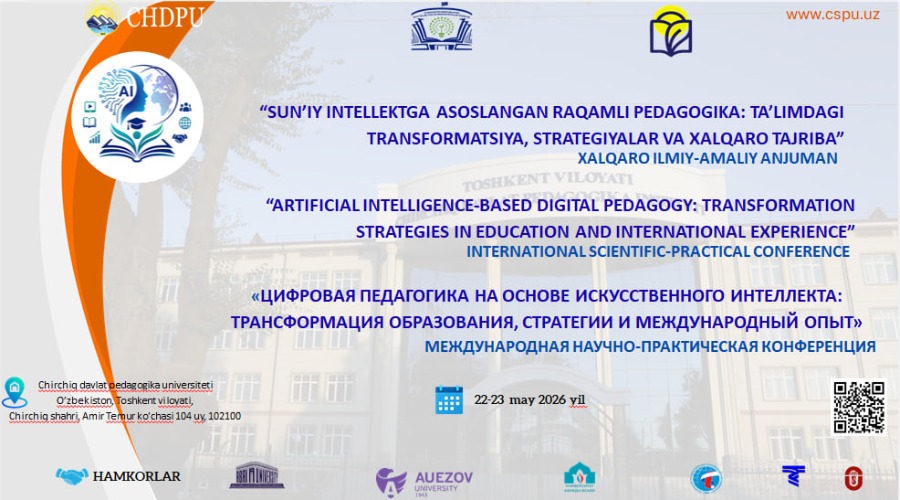
Under the 2026 plan of scientific events of the Ministry of Higher Education, Science and Innovation, the department held the international conference “Artificial Intelligence-Based Digital Pedagogy: Transformation Strategies in Education and International Experience” on 22–23 May 2026. It was opened by the Rector of the university, Professor G.I. Mukhamedov.
Papers covered the role of artificial intelligence in education, adaptive and personalized learning environments, and innovative technologies in teaching modern mathematics. Speakers represented:
- V.I. Romanovskiy Institute of Mathematics
- Osh State University (Kyrgyzstan)
- Tashkent University of Information Technologies named after Muhammad al-Khwarizmi
- Central Asian University
- Ajou University in Tashkent
- National University of Uzbekistan
International scientific and practical conference (2025)
By Order No. 490 of the Minister of Higher Education, Science and Innovation of the Republic of Uzbekistan dated 27 December 2024, the international conference “New methods and innovations in the integration of mathematics and information technologies” was held at Chirchiq State Pedagogical University on 18–19 April 2025.
Organizers:
- Ministry of Higher Education, Science and Innovation of the Republic of Uzbekistan
- Mukhtar Auezov South Kazakhstan University
- Sultan Idris Education University (Malaysia)
- Abai Kazakh National Pedagogical University
- Science and Innovation journal
- Chirchiq State Pedagogical University
Participants discussed introducing innovations in the integration of mathematics and IT into education, raising the research capacity of teachers, improving the quality and infrastructure of education, international experience, and innovative ideas of talented young people.


Information Systems and Technologies
60610100-Information Systems and Technologies – Bachelor's Degree
Academic degree - BACHELOR
Duration of study - 4 years
Type of education - credit-module
Form of education: full-time and evening
Sciences
Compulsory subjects
DAS1110 | Programming 1 |
MAB1306 | Database |
MTA1204 | Data Structures and Algorithms |
KOT1306 | Computer networks |
KIA1406 | Cybersecurity Basics |
SIA1406 | Fundamentals of Artificial Intelligence |
ATM1506 | Information system development methodologies |
BT1506 | Cloud technologies |
VT1506 | Web systems |
KHM1706 | Big Data Management |
Elective subjects
Subject 1 | Operating systems | Subject 5 | Mobile app development |
Windows server administration | Intelligent data analysis | ||
System programming | Network programming | ||
Competitive science 2 | Web programming | Subject 6 | Web design |
Real-time systems | Multimedia design | ||
Content management systems (CMS) | Building and Construction Design | ||
Subject 3 | Computer graphics | Subject 7 | Designing algorithms |
Multimedia database | Expert systems | ||
Flash technologies | Algorithm theory | ||
Subject 4 | Computer architecture | Subject 8 | Robotics and intelligent systems |
Virtual reality | Computer organization | ||
Practical software packages | Information technology in technical systems |
Subject 9 | Network security | Subject 13 | IoT technologies |
Geoinformation technologies | Electronic payment systems | ||
Information security | Data transfer and communication protocols | ||
Subject 10 | Creating computer games | Subject 14 | 3D technology |
Programming computer vision with Raspberry Pi | Technology management | ||
Adaptive e-learning platforms | Computer animation | ||
Subject 11 | Conducting business in the state language |
|
|
Programming computer vision with Raspberry Pi |
| ||
Computational linguistics |
| ||
Subject 12 | Information Systems Design Management (ERP and CRM System) |
|
|
Problem analysis and solution |
| ||
Image processing technologies |
|
Science programs
Information System Development Methodology.pdf
- Visualization of Information Systems Data.pdf
- Cloud technologies.pdf
- Programming 2.pdf
- Programming 1.pdf
- Big Data Management.pdf
- Cybersecurity Fundamentals.pdf
- Computer Networks.pdf
- Database.pdf
- Data Structures and Algorithms.pdf
- Fundamentals of Artificial Intelligence.pdf
- Web systems.pdf
60610500 - Artificial Intelligence
60610500 - Artificial intelligence - bachelor's degree
Academic degree - BACHELOR
Duration of study - 4 years
Type of education - credit-module
Form of education: full-time
Sciences
DAS1110 | Programming 1.2 |
MAB1306 | Database |
KIA1406 | Cybersecurity Basics |
MTA1204 | Data Structures and Algorithms |
EVS1306 | Electronics and Circuits 1 |
KOT1306 | Computer networks |
SIA1406 | Fundamentals of Artificial Intelligence |
EVS1406 | Probability and statistics |
INL1704 | Individual project |
KOK1506 | Computer vision |
NTC1606 | Neural Networks and Deep Learning |
ROB1506 | Robotics |
MOK1506 | Introduction to Machine Learning |
TTQ1704 | Natural Language Processing |
Resources
Information technology in education
Master's degree in Information Technology in Education
Program code: 70610105
Degree awarded: Master's degree
Forms of education: full-time
Program name: Information Technology in Education
Program duration: 2 years
In education, a student majoring in information technology must accumulate 30 credits per semester and 60 credits per academic year. The study period is 2 years, and the student must complete 120 credits by the end of the program.
The amount of ECTS credit in hours for a master's degree is 1 credit = 30 academic hours, and the student's annual study load is 60 credits = 1800 academic hours. Of these, 50% are divided into classroom hours and 50% are independent study hours. The amount of credits that a student must acquire during the semester includes compulsory and elective subjects specified in the subject catalog .
70610105 – Represents a set of requirements for all higher education institutions that train masters in the master's degree specialty of Information Technologies in Education. A higher education institution is considered to have the right to implement the main curriculum and subject programs when it has the authority to train personnel in this master's degree specialty.
have the right to engage in scientific and pedagogical research at sectoral research institutes of the Ministry of Preschool and School Education and the Ministry of Higher Education, Science and Innovation of the Republic of Uzbekistan or as independent researchers .
Areas of professional activity:
It covers a range of professional areas related to teaching subjects in the field of information technologies in higher education, advanced training and retraining, general secondary education, and vocational education institutions, conducting research work in the Academy of Sciences of the Republic of Uzbekistan and sectoral research institutes (RIIs), research institutions (RIs) and organizations, centers, and scientific and production associations in the fields of information technologies and pedagogy in education, and solving complex problems in the field of pedagogical and information technologies.
Types of professional activities:
- scientific research and pedagogical activities;
- exploitation activities;
- organizational and managerial activities;
- experimental research activities;
- information and analytical activities;
- production and management activities.
Requirements for professional competencies
- Possess a system of knowledge about scientific and scientific-technical worldviews, knowledge of the basics of general methodological sciences, current issues of state policy; have the ability to independently analyze social problems and processes;
- be able to independently acquire and improve new knowledge and organize their work on a scientific basis;
- understand and analyze problems of scientific, technical, social, and personal importance, relying on their individual knowledge;
- be able to use regulatory legal documents in their activities;
- have a culture of thinking, a certain way of thinking, and the ability to clearly express verbally and in writing;
- be able to creatively critically review and analyze the acquired knowledge, use it in scientific and scientific-technical creative activities, and make informed independent decisions;
- the formation of social responsibility aimed at realizing the results of scientific and scientific-technical creative activities;
- be able to use the basic laws of the sciences they have mastered in their professional activities, classify methods, and use methodological principles in their scientific and scientific-technical creative activities;
- mastery of of the foreign languages as a means of scientific communication and exchange of professional skills;
- master the methods of collecting, storing, processing and using information;
- be able to make informed independent decisions in their professional activities;
- have the ability to differentiate between information, knowledge, and data, and be able to use information technologies;
Requirements for internships
Scientific practice is aimed at strengthening and developing theoretical knowledge in general and specialized disciplines, as well as combining it with scientific research processes, and forming relevant practical skills, competencies, and qualifications. Scientific practice is conducted in the specialty.
Science code | Science qualification code | Names of academic subjects, blocks and types of activities | Clock | Credit | Semester |
1 |
| Compulsory subjects | 1200 | 40 | 1-3 |
1.01 | ITM1104 | Scientific research methodology | 120 | 4 | 1 |
1.02 | AIA1104 | Searching and extracting information | 120 | 4 | 1 |
1.03 | ILB1204 | Innovation and project management | 120 | 4 | 2 |
1.04 | ALT1204 | Design and analysis of algorithms | 120 | 4 | 2 |
1.05 | MFO1304 | Special subject teaching methodology | 120 | 4 | 3 |
1.06 | NEP1206 | Neuropedagogy | 180 | 6 | 2 |
1.07 | RTP1306 | Digital education and pedagogical competence | 180 | 6 | 3 |
1.08 | IPI1108 | Scientific pedagogical work | 240 | 8 | 1,2,3 |
2 .00 |
| Elective subjects | 480 | 16 | 1.3 |
|
| Qualification: Pedagogist-researcher | |||
| ILA1412 | Scientific practice | 360 | 12 | 4 |
| CIS1152 | Preparing a master's thesis | 1560 | 52 | 1-4 |
|
| Total: | 3600 | 120 |
Throughout the program, students will have the opportunity to work with modern, digital communication and educational environments, explore interactive methods, and engage in recommended or externally selected advanced subjects as electives.
One of these disciplines is the science of Artificial Intelligence Systems. In today's digital era, artificial intelligence (AI) technologies are deeply penetrating all industries. Therefore, the subject of "Artificial Intelligence Systems" occupies an important place in the higher education system. This subject forms not theoretical knowledge, but also practical skills in students. As a result, in the future they will be ready to create and use modern intellectual systems in various fields .
Within the framework of the program, students will be provided with theoretical knowledge in the areas of intelligent agents and decision-making mechanisms, knowledge modeling and expert systems, Machine Learning algorithms. Artificial neural networks and deep learning, Natural Language Processing. They will also be provided with practical technologies such as creating AI projects in Python and other programming languages, working with libraries such as TensorFlow, PyTorch, Scikit-learn, Computer Vision and voice recognition systems, developing Chatbots and smart assistants.
After mastering this subject, students can apply their knowledge to create intelligent learning systems and develop personalized learning programs.
In the subject of distance learning technologies, students study the history and stages of development of distance learning, types of learning systems and their advantages, digital learning platforms (Moodle, Google Classroom, EdX, Coursera, etc.), and the theoretical foundations of methods for integrating e-learning with traditional education.
skills that students will acquire will include:
- design and create distance learning courses;
- development of video lessons, electronic manuals, testing systems;
- organizing and managing virtual classrooms;
- remote monitoring and assessment of students;
- teaching using interactive programs (Zoom, MS Teams, Mentimeter, Kahoot).
Within the scope of the subject "Modern Programming Languages", students:
As a theoretical part :
- Development trends of programming languages (from C to Python, Java, JavaScript, C#, Go, Rust, Swift, etc. ).
- imperative, object-oriented , and functional programming paradigms.
- of syntax and semantics, comparison of syntax of different languages.
- Cross-platform capabilities (mobile, web, desktop, cloud).
- Which languages are preferable when working with artificial intelligence, databases, IoT, and Big Data.
Practical part:
- Python → artificial intelligence, data science, automation.
- Java / Kotlin → Android programming, large enterprise systems.
- JavaScript / TypeScript → web programming (frontend + backend: Node.js).
- C# → game development (Unity), business applications.
- Go, Rust → high-performance systems, server programming.
- Swift → iOS programming.
- Git and version control → team programming culture.
The "Modern Programming Languages" course prepares students not to write code, but also to create practical solutions on various platforms, develop innovative technologies, and find their place in the global IT market.
- Design and Analysis of Algorithms.pdf
- Information Search and Extraction.pdf
- Innovation and Project Management.pdf
- Special Subject Teaching Methodology.pdf
- Digital education and pedagogical competence.pdf
Doctoral programs (PhD, DSc )
Rizayeva Sanobar Davlataliyevna
Acting associate professor S.D. Rizayeva defended a dissertation on “Improving the learning process in pedagogical higher education institutions based on individual learning technologies” in the specialty 13.00.02 – Theory and methodology of education and upbringing (by field) and was awarded the degree of Doctor of Philosophy (PhD) in Pedagogical Sciences.
Ibodullayev Doniyor Kuvondikovich
Senior lecturer D.K. Ibodullayev defended a dissertation on “Improving the methodology of using VR and AR technologies in training future teachers” in the specialty 13.00.02 – Theory and methodology of education and upbringing (by field) and was awarded the degree of Doctor of Philosophy (PhD) in Pedagogical Sciences.
Recommended literature for the Information Systems and Technologies major
Recommended English-Language Literature
The following English-language textbooks and reference books are recommended for students of the Information Systems and Technologies specialty. These resources cover fundamental concepts, business applications, and advanced topics in information systems.
Core Textbooks
- Foundations of Information Systems – OpenStax (Free)
https://openstax.org/details/books/foundations-information-systems - Information Systems for Business and Beyond – Open Textbook Library (Free)
https://open.umn.edu/opentextbooks/textbooks/information-systems-for-business-and-beyond - Information Systems: A Manager’s Guide to Harnessing Technology
https://open.umn.edu/opentextbooks/textbooks/information-systems-a-manager-s-guide-to-harnessing-technology - Managing and Using Information Systems: A Strategic Approach
https://www.wiley.com - Information Systems: What Every Business Student Needs to Know
https://www.routledge.com
Supporting and Reference Literature
- Code: The Hidden Language of Computer Hardware and Software – Charles Petzold
https://www.microsoftpressstore.com - The Secret Guide to Computers – Russ Walter
https://en.wikipedia.org/wiki/The_Secret_Guide_to_Computers - Computer: A History of the Information Machine – Martin Campbell-Kelly, William Aspray
https://www.routledge.com
Advanced and Specialized Topics
- Business-Driven Information Systems
https://guides.library.ubc.ca/mis/books - Information Systems Project Management – David Olson
https://guides.library.ubc.ca/mis/books - Interconnecting Smart Objects with IP – Jean-Philippe Vasseur, Adam Dunkels
https://www.oreilly.com
- 19 Nov, 2026
- Announcements
International Conference “Artificial Intelligence-Based Digi...
The Department of Information Technologies and Artificial Intelligence of the Faculty of Exact Scien...
Read More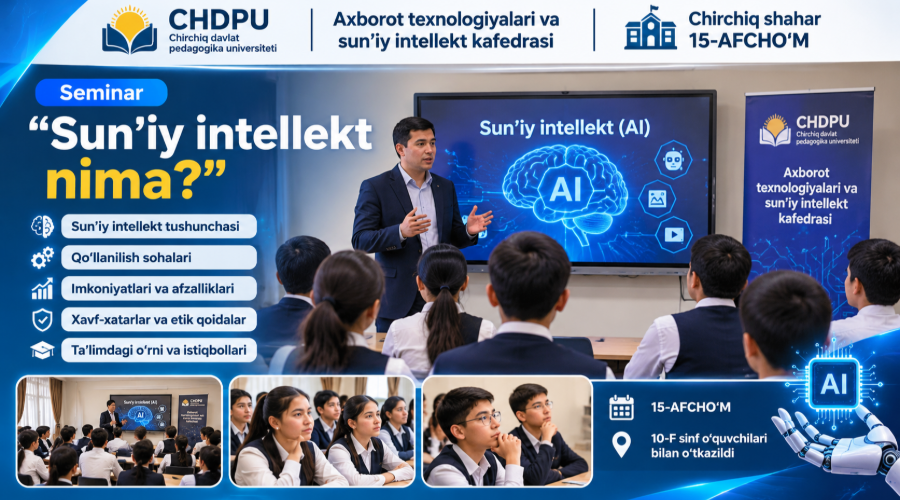
- 18 Nov, 2026
- Announcements
“A seminar on «What is Artificial Intelligence?» was organiz...
Read More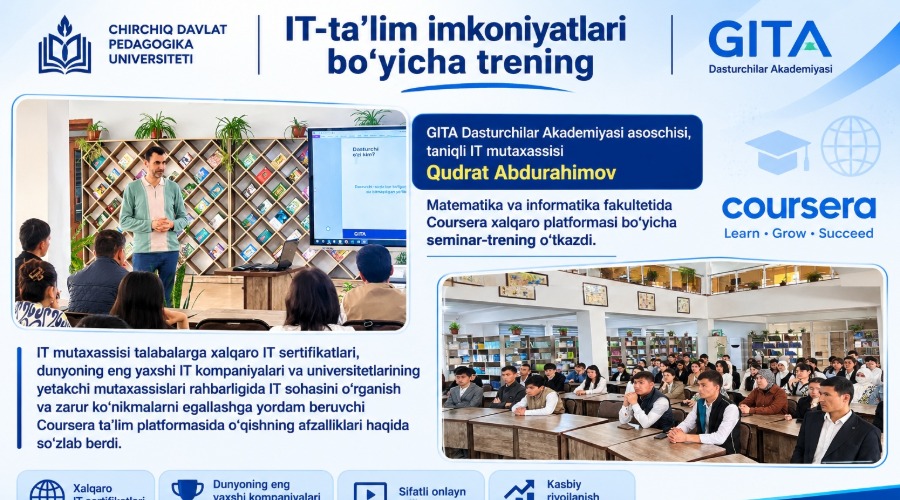
- 12 Nov, 2026
- Announcements
IT-taʼlim imkoniyatlari boʻyicha trening
“Bugungi bilim — ertangi muvaffaqiyat poydevori!” Dunyo miqyosida raqobatbardosh mutaxassis bo‘li...
Read More
- 13 May, 2026
- Announcements
“Informatika va axborot texnologiyalari” fanidan Respublika...
Muhammad al-Xorazmiy nomidagi Toshkent axborot texnologiyalari universiteti Samarqand filialida “Inf...
Read More
- 08 Apr, 2026
- Announcements
“KARYERA KUNI”: BITIRUVCHILAR UCHUN REAL IMKONIYATLAR MAYDON...
2026-yil 9-aprel kuni Chirchiq davlat pedagogika universitetida an’anaga aylangan “Payshanba — yoshl...
Read More
- 15 Mar, 2026
- Announcements
“Informatika va axborot texnologiyalari” fanidan Respublika...
“Informatika va axborot texnologiyalari” fanidan Respublika fan olimpiadasini o‘tkazish
Read More
- 13 Mar, 2026
- Announcements
TOKAI UNIVERSITY DELEGATSIYASINING CHIRCHIQ DAVLAT PEDAGOGIK...
Chirchiq davlat pedagogika universitetida Tokai universiteti (Yaponiya) muhandislik maktabi vakillar...
Read More
- 20 Nov, 2025
- News
Xalqaro ilmiy-amaliy safar
“Axborot texnologiyalari va sun’iy intellekt” kafedrasi professor-o‘qituvchilarining Xoja Ahmet Yasa...
Read More