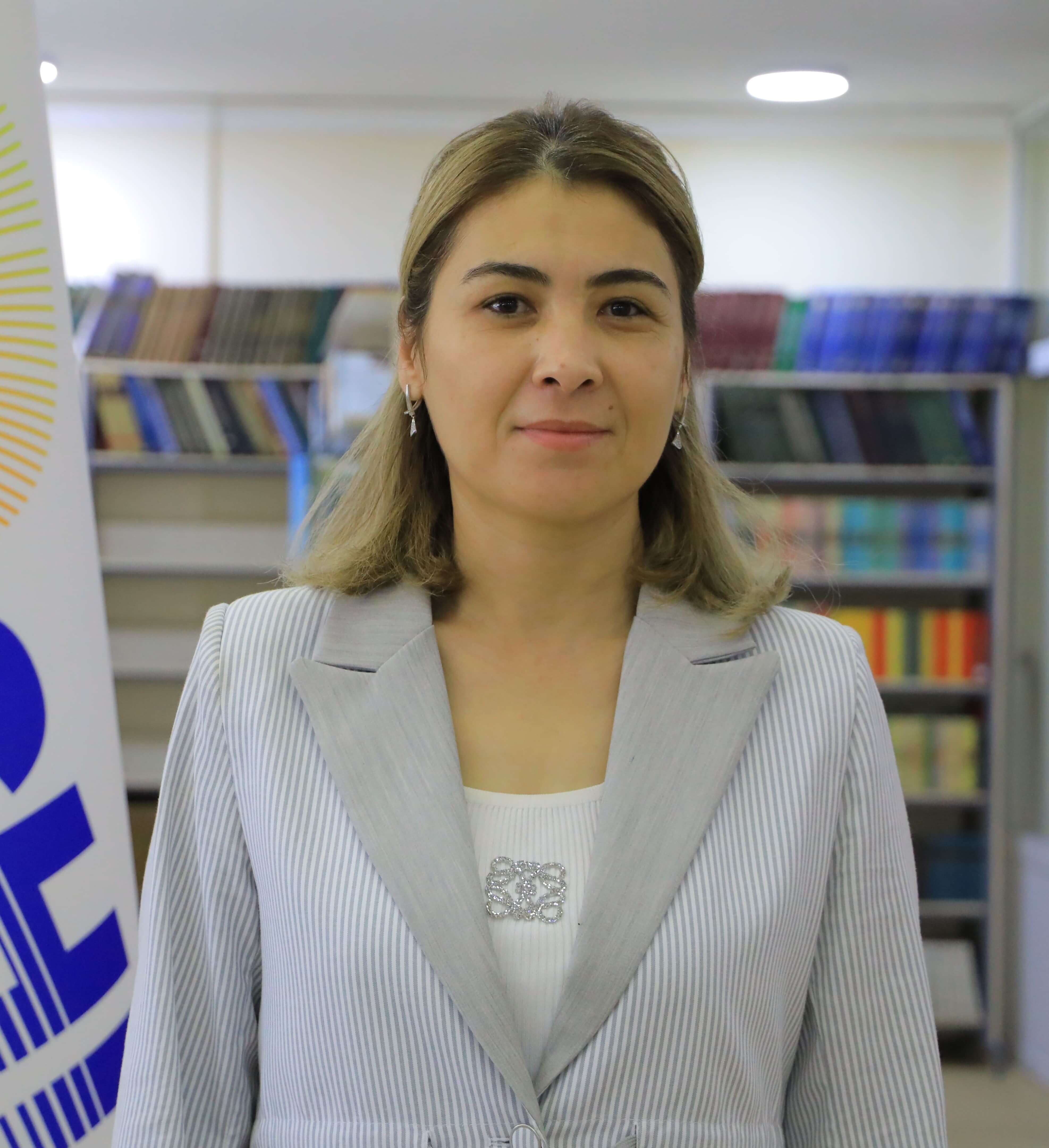
Feruza Djabbarova is a Senior Lecturer in English with 10 years of teaching experience at Chirchiq State Pedagogical University. Her research focuses on preparing future foreign language teachers to work in inclusive education. She is a PhD candidate in Special and Inclusive Education, and her dissertation focuses on teaching foreign languages in inclusive education.
Education
MA, Tashkent Regional State Pedagogical Institute, 2006–2008
BA, Tashkent Regional State Pedagogical Institute, 1999–2003
Certifications
TEFL (Teaching English as a Foreign Language)
TESOL (Teaching English to Speakers of Other Languages)
Research Interests
Inclusive education, bilingual education, foreign language teaching methodology, teacher education
Teaching
English, Foreign Language, Foreign Language for Professional Purposes
Publications
Her articles are published in journals indexed in Scopus and Web of Science. A full list is available on her Scopus, ORCID and Google Scholar profiles.
Collaboration
She welcomes collaboration with international colleagues on joint research, co-authored publications, and academic exchange programs.
My career began in 1999 when I became a student at the Tashkent Regional State Pedagogical Institute. Below is a summary of my professional experience:
1999–2003 – Student, Tashkent Regional State Pedagogical Institute
2004–2006 – English teacher, School No. 12, Tayloq district
2006–2008 – Master's student, Tashkent Regional State Pedagogical Institute
2007–2013 – Teacher, Department of Foreign Languages, Tashkent Regional Pedagogical Institute
2015–2016 – English teacher, Angren College of Automation and Service
2016–2017 – Senior teacher, TSHPKQTMOI (Technical College for Professional Qualifications)
2017 .02.02-2017.30.08 English teacher, Uzbek State University of Physical education and Sport, Department of English
2017.05.09–present – Senior teacher, Interfaculty Department of Foreign Languages, Chirchiq State Pedagogical University
At each workplace, I have always strived to perform my duties with dedication and high responsibility
As an English language teacher, my main goal has always been not to teach, but also to inspire a love for language learning in the hearts of young people. I am proud that some of my students have succeeded in international competitions and been accepted into foreign universities.
In my teaching, I focus on using modern teaching methods, interactive technologies, and a communicative approach. At the university, I regularly take part in methodological work, open lessons, training sessions, and professional workshops. I am always motivated to improve my professional skills and to exchange experience with colleagues, which helps me to grow continuously in my career.
Djabbarova F.O. The Role of Psycholinguistics in Language Learning and Teaching // International Journal of Innovative Research in Science, Engineering and Technology. Impact factor SJIF 2022 = 8.118. ISSN: 2319-8753. Hindiston. Volume: 11. Issue: 03, 2022. – P. 2615-2619.
Djabbarova F.O. From Theory to Practice: The Role of Psycholinguistics in Teaching English // Journal of Pedagogical Inventions and Practices. Impact factor SJIF 2023 = 6.798. ISSN: 2770-2367. AQSH. Volume: 27, 2023. – P. 17-22.
Djabbarova F.O. The Confluence of Thought, Language, and Emotion in Teaching English // So‗z san‘ati xalqaro jurnali. Toshkent. – №6(6), 2023. – B. 20-26.
Djabbarova F.O. Aniq fanlar yo‗nalishi talabalarining ingliz tili ko'nikmalarini rivojlantirishda psixolingvistik yondashuvning roli // Namangan davlat universiteti ilmiy axborotnomasi. Namangan. – №10, 2024. – B. 737-743.
Djabbarova F.O. Optimizing English Language Instruction with
Psycholinguistic Methods // ―Pedagogik ta‘lim klasteri: muammo va yechimlar‖ xalqaro konferensiyasi materiallari to'plami, Chirchiq, 2021, 25-26 iyun. – B.1435-1445.
Djabbarova F.O. The Need for a Psycholinguistic Approach to English Language Teaching // ―Ijtimoiy-gumanitar fanlarning dolzarb masalalari‖ xalqaro konferensiyasi materiallari to‗plami, Toshkent, 2022, aprel. – B. 1208-1210.
Djabbarova F.O. Ingliz tilini o'qitishda psixolingvistik tamoyillar // ―Sifatli ta‘lim – O'zbekiston taraqqiyotining poydevori‖ respublika konferensiya materiallari to'plami, Toshkent, 2023, 6-may. – B. 656-660.
Djabbarova F.O. The Efficacy of Psycholinguistic Techniques in English Language Education for Exact Science Students // ―Zamonaviy pedagogika va psixologiyaning dolzarb masalalari‖ respublika konferensiya materiallari to'plami, Toshkent, 2024, 27-mart. – B. 325-329.
Djabbarova F.O. ―Xorijiy til‖ o'quv qo'llanma // Toshkent, 2024. – 98 b.
Djabbarova F.O. Competence-based approach in teaching foreign languages // ISJ Theoretical & Applied Science. Impact factor SJIF 2021 = 7.184. ISSN: 24 09-0085. Qozog'iston. Volume: 06. Issue: 98, 2021. – P. 589-592.
Dajabbarova F.O. Psixolingvistikaning zamonaviy tamoyillari va uni ta‘lim tizimiga tadbiq etish // Экономика и социум. Rossiya Federatsiyasi. – №3-2(94), – B. 1142-1146.
Djabbarova F.O. The Essence of the Psycholinguistic Approach in Teaching Foreign Languages // Current Research Journal of Pedagogics. AQSH. Volume:Issue: 11, 2024. – P. 54-57.
Djabbarova F.O. The Important Role of Content Based Approach in Teaching ESP Groups // ―Academic research in educational sciences‖ ilmiy-metodik jurnal.Impact Factor SJIF 2021 = 5.723. ISSN: 2181-1385. Chirchiq. Volume: 02. Issue: 3, 2020. – P. 336-339.
Djabbarova F.O. The Advantages and Importance of Learning and Using Idioms in English // ―Zamonaviy filologiya va lingvodidaktikaning dolzarb masalalari‖ xalqaro konferensiyasi materiallari to'plami, Chirchiq, 2024, 23-24 aprel. – B. 560-562.
Djabbarova F.O. Use of Information Technologies in Foreign Language Lessons // ―Ta‘lim jarayonida raqamli texnologiyalarni joriy etish samaradorligi‖ respublika konferensiyasi materiallari to'plami, Chirchiq, 2023, 20-oktabr. – B.221-225.
Djabbarova F.O Exploring Gothic-Themed Lexemes and Their Cultural Connotations in English and Uzbek: An Educational Perspective// ― International Journal of Language Education// ―Indoneziya, 2024, 655-677 https://ojs.unm.ac.id/ijole/article/view/6999