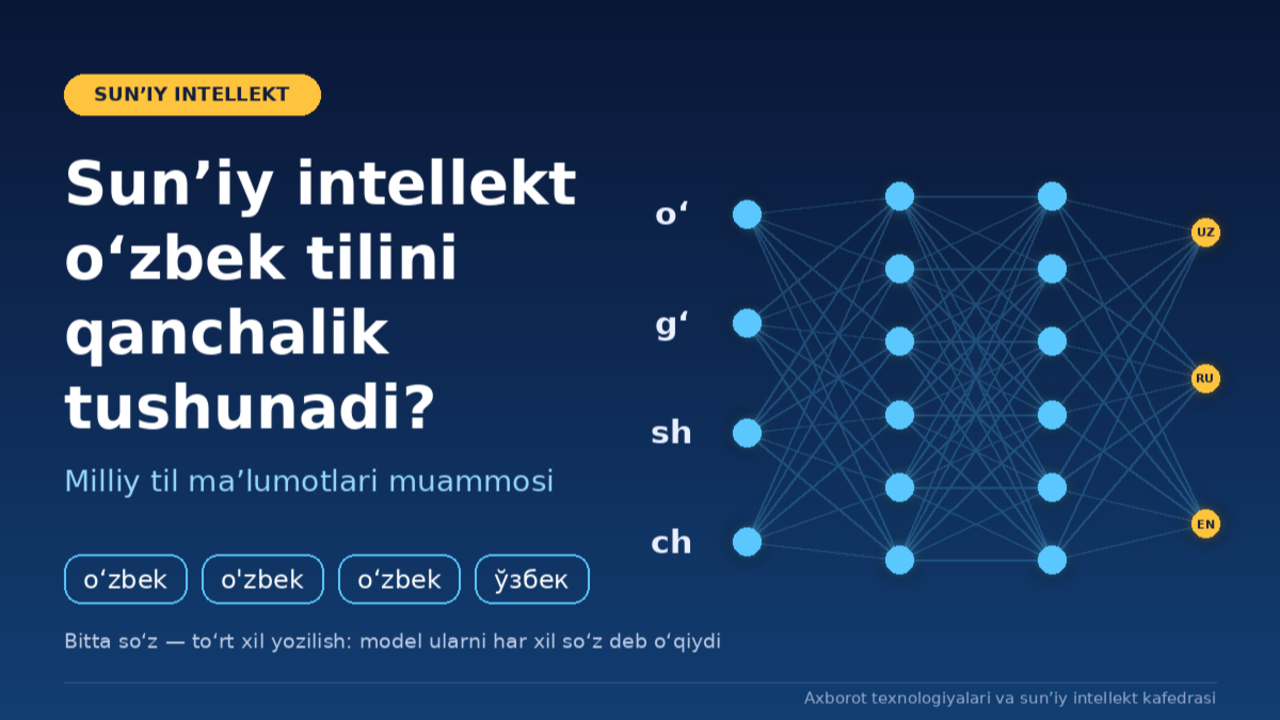
Today many of our students use AI assistants such as ChatGPT and Gemini. Yet few notice one thing: when a question is asked in English, the answer is accurate and thorough, while in Uzbek it often contains grammatical errors, awkward machine-translation-like sentences and sometimes even incorrect information. The main reason is that Uzbek is considered a “low-resource” language for artificial intelligence.
The root of the problem
Large language models are trained on billions of texts from the internet. Compared with English, there are very few high-quality, edited digital texts in Uzbek. The specific features of our language make things even harder:
- agglutinative structure: many suffixes attach to a single word, producing thousands of word forms;
- the Latin and Cyrillic scripts are used in parallel;
- the letters o‘, g‘ and the apostrophe are typed with different characters.
As a result, a model treats different spellings of the same word as separate words.
Attention at the state level
The issue is also being raised at the level of state policy. Presidential Resolution No. PQ-358 of 14 October 2024 approved the “Strategy for the Development of Artificial Intelligence Technologies until 2030”. At a meeting held in October 2025, it was emphasized that AI programs must understand the Uzbek language perfectly, and the task was set to digitize literature, research papers and documents in Uzbek and to create an “Uzbek Language Corpus”.
What can higher education do?
In my view, pedagogical universities can play an important role in this work:
- Publishing students’ course papers, graduation theses and research articles in a unified Latin orthography and in open digital form.
- Running practical projects with computer science students on cleaning and annotating Uzbek texts and building small datasets.
- Developing tools such as spell checkers and terminology dictionaries in cooperation between language and computer science departments.
- Teaching students to critically verify AI answers, especially those in Uzbek, by comparing them with sources.
Conclusion
How well artificial intelligence “speaks” Uzbek does not depend on programmers alone. It is the work of teachers, students and everyone who writes in Uzbek. Every high-quality Uzbek text created today becomes the foundation of tomorrow’s national artificial intelligence.
Oybek Rajabov, Senior Lecturer, Department of Information Technology and Artificial Intelligence