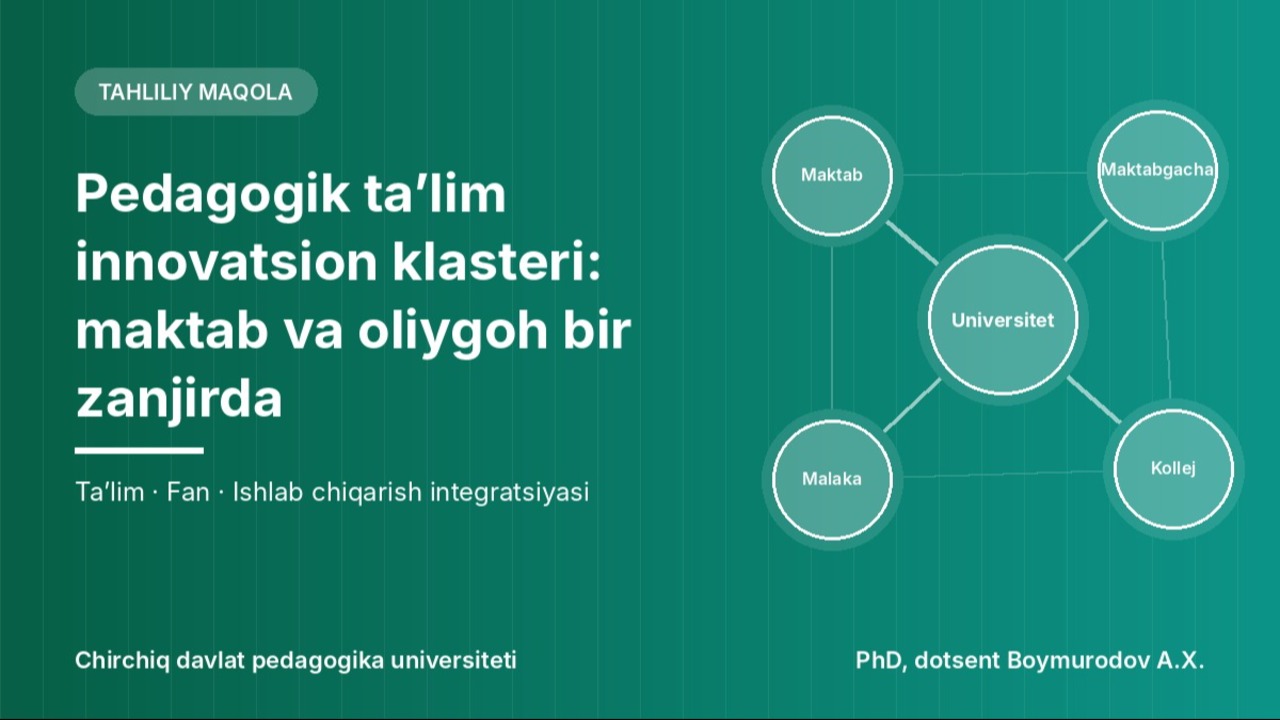
The term "cluster" comes from economics, where it means a group of organisations linked by a common goal. In education, a cluster brings preschool, general secondary, higher education and professional development institutions into a single system in which each link builds on the results of the others.
The Chirchik experience
The "Innovative Cluster Model of Teacher Education" has become the main strategic research direction of Chirchik State Pedagogical University. The university develops the cluster as a practical mechanism for integrating education, science and production in teacher education. It is a large-scale research and practice project recognised as the Tashkent region experience, whose ultimate aim is to raise the capacity of the region's preschool and public education system. yuzyuz
How it differs from ordinary cooperation
A cooperation agreement is often limited to one-off events. In a cluster the link is permanent and two-way:
- The school gives the university a real learning environment: students do their teaching practice there, and research gets a testing ground.
- The university gives the school academic and methodological support, new technologies and professional development for teachers.
- The result: future teachers know the school from the inside before they graduate, and schools gain ready-trained staff.
Core principles
The plan for an innovative cluster of teacher education in the Tashkent region rests on five principles: consistency, continuity, sequence, modernity and goal orientation. They were set out in a study of forms of integration between general schools and higher education institutions (European Journal of Research and Reflection in Educational Sciences, 2020).
The case of informatics
The study "Innovative cluster model of teaching informatics and information technologies in general secondary education" shows that informatics is one of the best-suited subjects for a cluster approach:
- university computer labs and software are opened to school pupils;
- students run clubs and extra classes in schools;
- school teachers learn new technologies through university seminars and training;
- online platforms connect cluster members remotely.
Conclusion. An education cluster tackles a problem no single institution can solve alone: the gap between teacher training and the quality of schooling. Within it, the university becomes the academic and methodological centre of the region's education system, not just a "producer of graduates".
Author: Adham Xushimqulovich Boymurodov, PhD, Associate Professor, Department of Information Technologies and Artificial Intelligence.