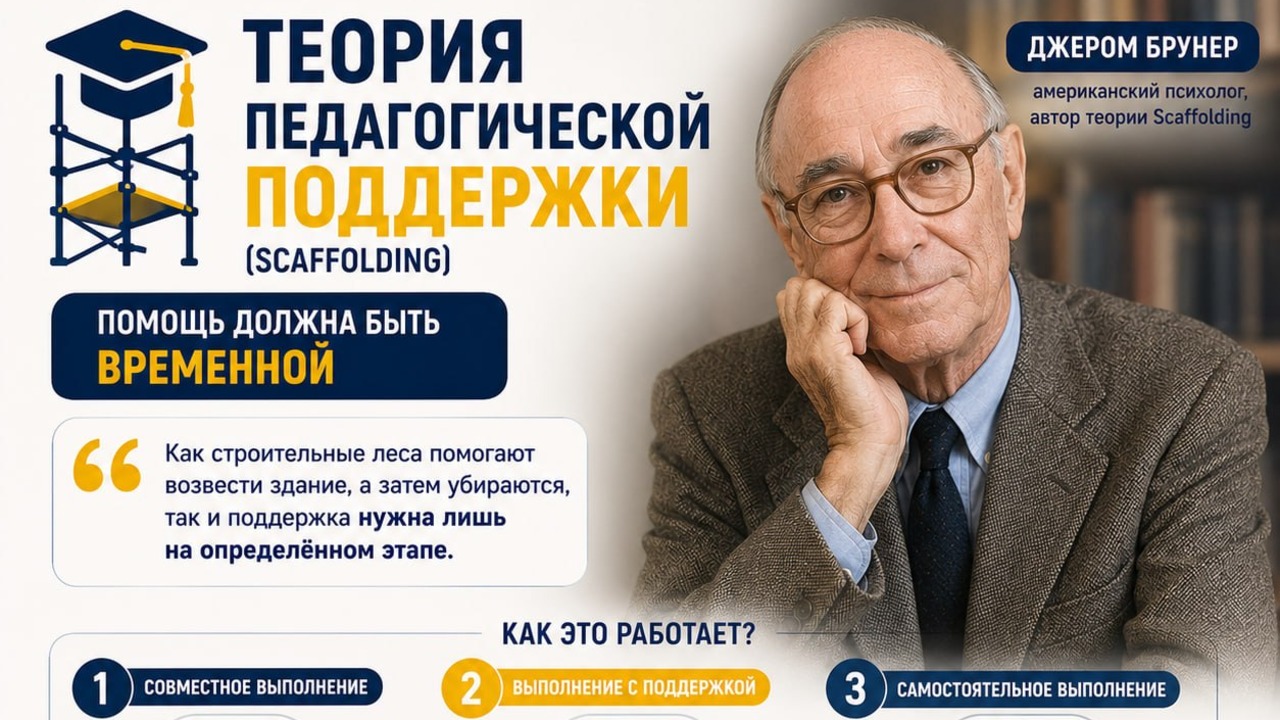
The biggest mistake in teaching future computer science teachers to work independently is to throw students straight into “do it yourself”. Strong students race ahead while the rest end up copying. The Scaffolding strategy solves this by gradually withdrawing the teacher’s support.
Five stages
- Modeling. The teacher demonstrates the AND operation: the logical expression is written and the logic circuit is drawn.
- Guided Practice. Using a handout, students simulate the AND operation in Tinkercad, build an LED circuit and check the result — whether the LED is on or off.
- Collaborative Work. Students form groups of 3–4 and solve a real-life problem using OR, NOT or XOR. Each student has a role: analyst, designer, programmer or coordinator.
- Independent Practice. The student identifies the problem, formulates a question (IBL), develops an idea and plans a project (PjBL), and identifies knowledge gaps and gathers data (RBL).
- Mastery. Peer teaching, summarising and reflection: a topic counts as learned only when the student can explain it to someone else.
Why simulators?
Tools such as Tinkercad, Logisim, CircuitVerse and Arduino make mistakes “cheap”: if a circuit is wired wrongly, nothing breaks, and the student looks for the cause on their own. That search is the core of independent research activity.
How to assess the outcome
It is important to assess the process, not only the final answer. We use four criteria:
- Cognitive activity — mastery of AND/OR/NOT/XOR operations based on Bloom’s taxonomy;
- Inquiry — independent work with simulators, databases and literature (RBL, IBL);
- Creativity — building a project and adapting it to a real-life system (PjBL);
- Adaptability — choosing and using digital tools to suit the task.
Conclusion
Scaffolding takes more preparation from the teacher, but the effect is clear: the student moves from observer to researcher. The model was developed in the PhD study “Improving the software and methodological support for preparing future computer science teachers for independent research activity” and tested with 376 students.