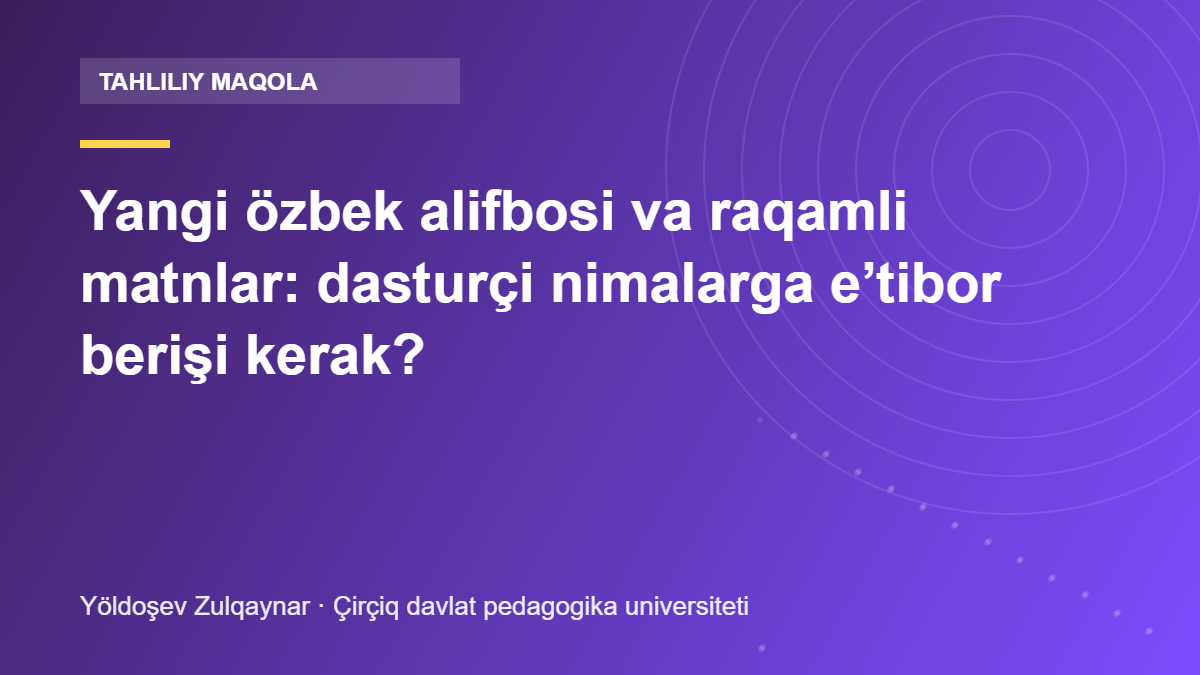
On 21 October 2026 the law on improving the Latin-based Uzbek alphabet was signed. Under it, O‘, G‘, Sh and Ch are replaced by Ö, Ğ, Ş and Ç. This is not only a linguistic matter: it affects thousands of websites, databases and programs.
Technical problems of the old alphabet
In the current alphabet the letter “o‘” has been written with different characters: a plain apostrophe, a turned comma, a special modifier letter. To a computer these are different characters. As a result the same word is stored in several forms in a database, and search misses some of them.
Tasks for developers
- Encoding. All systems should use UTF-8; the new letters already exist in Unicode.
- Normalisation. The various apostrophes in old texts should first be reduced to one form and then converted to the new letters.
- Careful conversion. When replacing “sh” and “ch” automatically, foreign words, names and links must not be broken.
- Search. During the transition users may search in either spelling, so search should find both forms.
- Sorting and addresses. Alphabetical order and website addresses (URLs) need to be adapted to the new letters.
An opportunity for teaching
This topic makes an excellent practical assignment for informatics students: write a small program that converts old text to the new alphabet correctly without breaking foreign words. Students learn character encoding, string handling and testing on a real and timely problem.