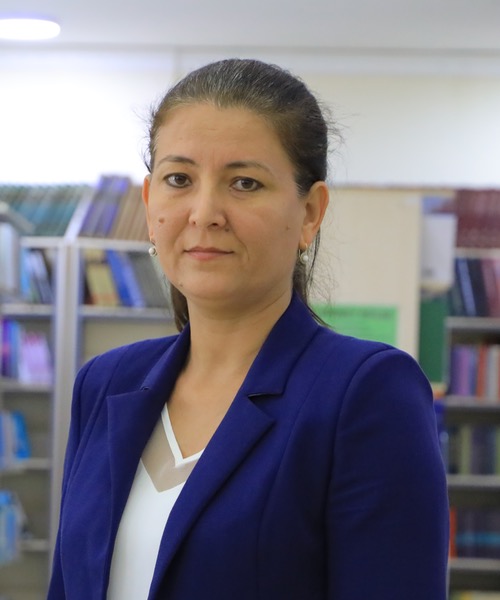
Yusupova Mukhabbat Anatolevna — A knowledgeable, experienced, dedicated teacher, Highly qualified specialist who focuses on the individual characteristics of students, helps them to increase their interest in the English language, supports autonomous learning, creative thinking and the cultural aspects of the language.
Yusupova Mukhabbat Anatolevna — was born on July 15, 1975 in Yukorichirchik district of Tashkent region. In 1997, she successfully graduated from the Uzbek State World Languages University. Currently, she works as the Head of the Department of Linguistics and English Teaching Methodology, Faculty of Tourism, Chirchik State Pedagogical University.
Yusupova Mukhabbat Anatolevna - worked in several
organizations during her career.
1992–1997
Education
Student
Uzbek State University of World Languages
1997–2012
Lecturer
Lecturer, Department of Theory and Practice of English Translation
Uzbek State University of World Languages
2012–2013
Teacher
English Teacher
6th Secondary School, Yukorichik District, Tashkent Region
2013–2017
Department
Senior Lecturer, Department of Language and Literature Education
Tashkent Regional Institute for Retraining and Advanced Training of Public Education Employees
2017–2018
Teacher
English Teacher
Department of Languages, Chirchik State Pedagogical Institute, Tashkent Region
2018–2022
Management
Acting Head, Department of English
Chirchik State Pedagogical Institute
2022–2023
Management
Head, Department of English
Chirchik State Pedagogical University
2023
Management
Head, Department of Linguistics and English Language Teaching Methods
Chirchik State Pedagogical University
Yusupova Mukhabbat Anatolevna's research focuses on English language teaching methodology, linguistics, and e-learning resources. She has been conducting the research on the methodology of using discourse-based e-resources in integrative English language teaching.
Scientific interests include:
Improving the methodology of teaching English based on technologies
Methodological foundations of language teaching methodology based on the corpus approach
English language teaching system based on web quests and projects
Increasing motivation through gamification elements
Methodological foundations of integrative teaching English
Integration of science and language through CLIL (Content and Language Integrated Learning) technology
Using electronic textbooks and interactive materials
Peculiarities of teaching English in primary grades
Methodological aspects of teaching language in inclusive education
Methods of assessing students' creative work
Published teaching and methodological manuals
Textbook
Intercultural communication, 2020
Textbook In the era of globalization, the ability to work and study with representatives of different nationalities; English is not just a language, but also a cultural bridge; In order to avoid mistakes, misunderstandings and create a friendly environment between people, it includes the study of processes such as recognizing and understanding one's own and other people's cultures, traditions, and values, effective communication skills despite cultural differences, and the ability to behave freely and adapt in different cultural environments.
Textbook
History of English and American Literature, 2022
A textbook that includes literary works of Great Britain and works rich in themes of national history, social conflicts, and personal freedom of the United States. Its history begins with the Anglo-Saxon period (Beowulf) and is enriched by classical writers such as Shakespeare, Chaucer, Austen, Dickens, and Woolf. It covers the period from the Renaissance to the modernism of the 20th century.
Textbook
Methodology of Teaching Foreign Languages with Educational Games, 2022
The textbook includes a methodological approach aimed at developing language skills in students or pupils through the use of game elements in the learning process.
Study Guide, 2023
Reading and Writing Practice
The coursebook is designed to develop skills such as understanding the text, sorting, analyzing information, drawing conclusions, correctly using reading strategies in various texts, and being able to write clearly, coherently, and grammatically correct in writing in various types of writing (letters (formal and informal), short passages (paragraph writing), articles and essays, reports).
Textbook
Country Study, 2024
The textbook is aimed at enriching students' cultural, political, social, geographical, and historical knowledge in the process of learning English. This educational resource forms not the language knowledge of the language learner, but also the ability to communicate interculturally.
Textbook
Written and Oral Translation Competence, 2024
The textbook is a set of knowledge, skills and abilities necessary to form and develop the future specialist's ability to correctly translate a written text from language into another while preserving its meaning and style, as well as the ability to hear, understand and correctly translate speech in the form of Simultaneous or Explanatory Translation. It includes not language knowledge, but also intercultural communication, field-specific knowledge and the ability to think quickly.
Monographs
Methodology of training future English teachers to use Project technology, 2024
The monograph is a research work that covers the methodological foundations, theoretical and practical approaches to the effective use of Project technology (Project-based learning) in pedagogical education, in particular, in the process of training English teachers.
Recommended topics for a Bachelor's thesis
- Enhancing students' language learning based on creative, individual approaches
- Creating English lessons with digital learning tools
- Teaching English to students through individual learning paths
- Dictionaries' impact on teaching History lexicon
- Using individual techniques to teach biology students English terminology
- Using artificial intelligence to teach word combinations
- The importance of enhancing vocabulary for students in non-language fields
Recommended topics for a Master's thesis
- Developing students' linguistic and methodological thinking through individual creative approaches.
- Methodology for designing English lessons using electronic educational resources.
- Teaching students English based on individual learning trajectories.
- The role of terminology dictionaries in teaching professional vocabulary (a case study in teaching History).
- Technology of teaching terminology to Biology students based on individual approach (as an example of the English language.
- Developing Intercultural Competence in English Language Teacher Training Programs
- The importance of improving vocabulary of non-linguistic specialties students.
Recommended topics for a Doctor of Philosophy (PhD) dissertation
- “An individual creative approach to developing students' linguo-methodological thinking (On the example of Foreign Language and Literature students (English))
- “Methodology of using electronic educational resources in training future English teachers to design and conduct English lessons
- “Teaching English to students based on an individual learning trajectory (On the example of non-philological fields of study)”
- “Using a terminological dictionary in teaching professional vocabulary to students in the humanities (On the example of the history major)”
- “Improving the methodology of teaching biology terminology in English”
- “Methodology of teaching collocations to students using corpus technologies and Artificial Intelligence based on an individual approach (On the example of Foreign Language and Literature major)”
- “Improving the methodology of teaching terminological vocabulary in developing the communicative competence of non-philological students”
- “Pedagogical models of teaching children with special educational needs in general education institutions”
- “Pedagogical foundations of an individual approach to developing students' personal abilities”
- “Enhancing the effectiveness of students' independent work based on interactive technologies in English language teaching”