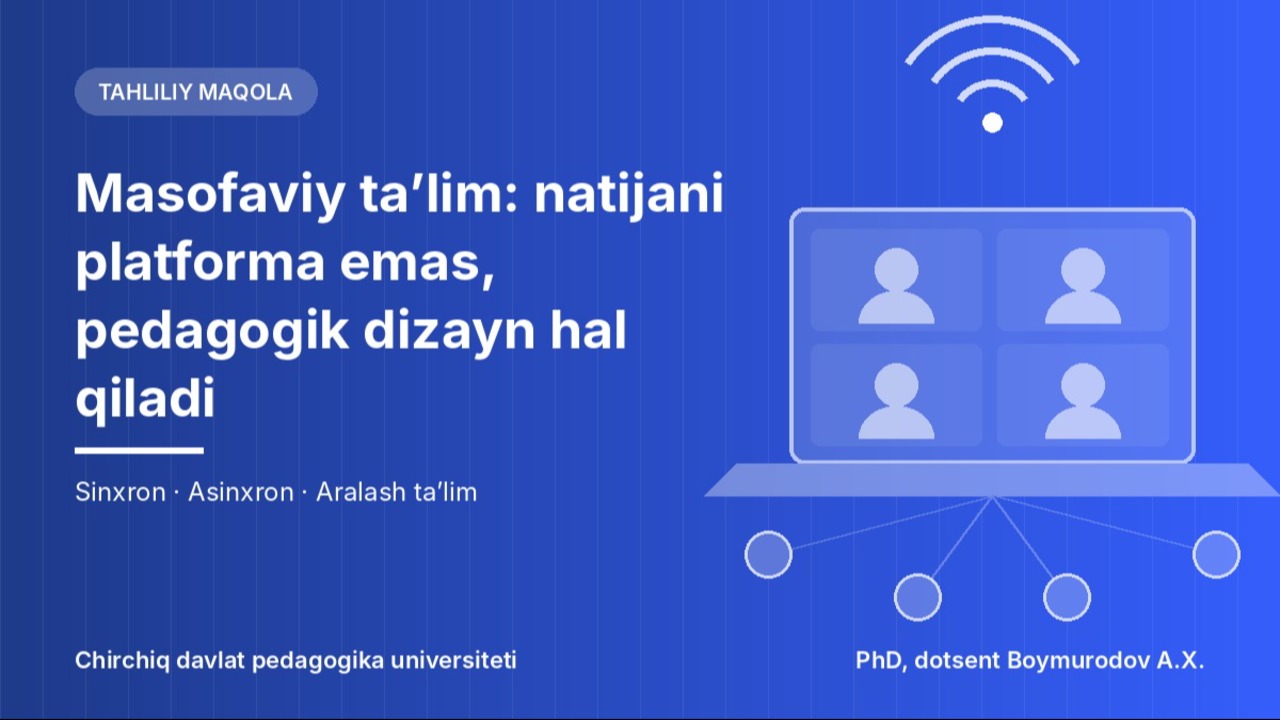
The most common mistake when moving to distance learning is to treat it as a technical task: a platform is chosen, lectures are recorded and the course is considered "ready". In practice, students quickly drop such courses. The quality of distance learning depends on pedagogical design, not on the platform.
Three main models
- Synchronous: teacher and students are online at the same time (Zoom, Microsoft Teams, Google Meet). This suits discussion and live Q&A.
- Asynchronous: students study at their own time and pace (Moodle, Google Classroom). This suits independent learning.
- Blended: classroom and online sessions are combined. In the flipped classroom, theory is studied at home and class time is used for practice.
How to design a course
- Split the material into short modules, each with one clear goal, a short video or text and a related task.
- End every module with an activity: a quiz, a practical task, a forum discussion or a mini-project.
- Keep regular contact: timely feedback and answers stop students from feeling isolated.
The Community of Inquiry model stresses three kinds of "presence" in online learning:
- teaching presence: organising and guiding the course;
- social presence: communication and collaboration among students;
- cognitive presence: thinking, analysis and applying knowledge.
Without any one of them, a course becomes little more than a file archive.
Assessment. Relying on a final test alone is ineffective online, especially now that students can get ready answers from AI. Formative assessment that shows the process works better: staged assignments, e-portfolios, project defences and reflective writing.
Challenges and solutions
- Poor internet: downloadable, mobile-friendly materials.
- Low motivation: clear deadlines, short tasks and visible progress.
- Isolation: group projects, forums and online office hours.
Conclusion. Distance learning is not a copy of a classroom lesson but a pedagogical environment of its own. Designed well, it builds students' independence, digital competence and responsibility for their own learning.
Author: Adham Xushimqulovich Boymurodov, PhD, Associate Professor, Department of Information Technologies and Artificial Intelligence.