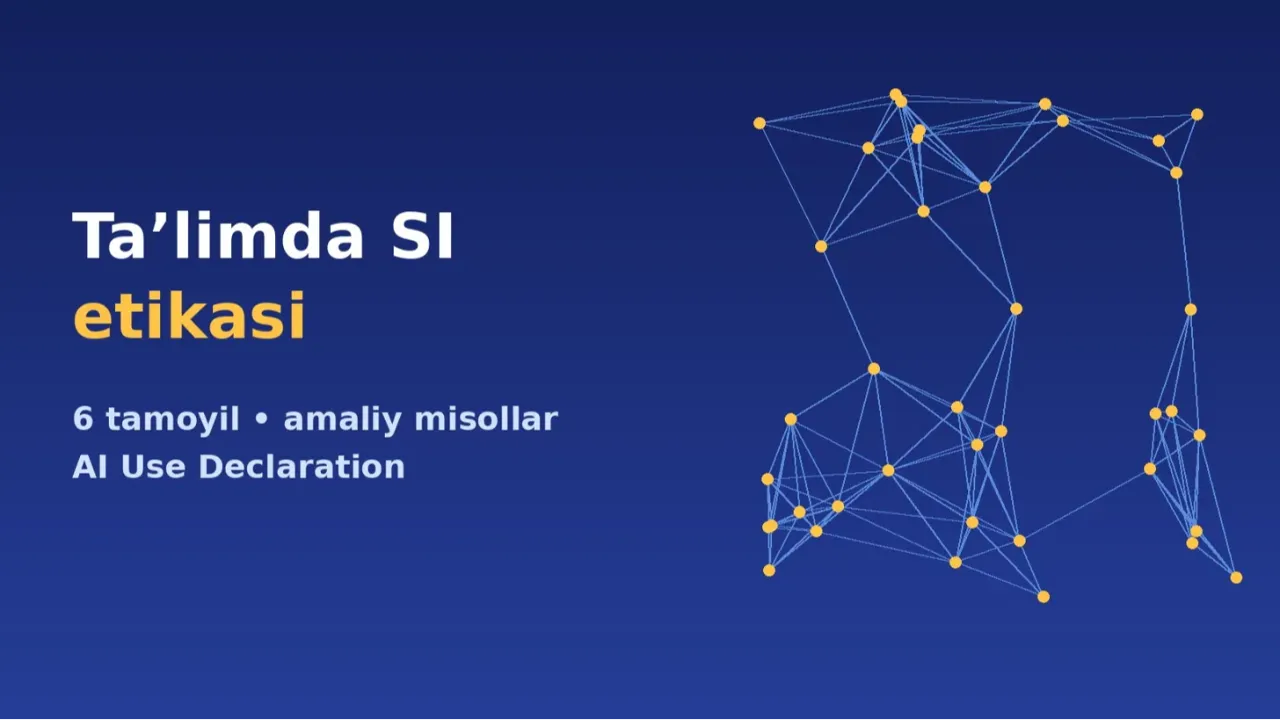
Artificial intelligence (AI), especially generative AI tools, has entered the educational process very rapidly in recent years. Students actively use these tools for writing texts, producing code and creating images, while teachers use them to prepare teaching materials, assignments and assessment criteria. They create great opportunities for personalizing learning and saving teachers' time. However, like any powerful technology, AI must be applied according to clear ethical rules. This article proposes six ethical principles for using AI in education, practical examples from information technology courses and a sample “AI Use Declaration” for students.
Why does ethics matter?
AI systems can make mistakes, “invent” sources that do not exist and reproduce biases contained in their training data. They process the data users enter, which raises the question of personal data protection. If a student submits AI-written text or code as their own work, this contradicts academic integrity. Therefore, the question should not be “should we use AI?” but “how do we use it correctly and responsibly?”.
Regulatory framework
Resolution No. PP-358 of the President of the Republic of Uzbekistan of 14 October 2024 approved the “Strategy for the Development of Artificial Intelligence Technologies until 2030”. Alongside introducing AI technologies into the social sphere, including education, the Strategy sets out the priority of human interests and the improvement of the regulatory framework in this area. Internationally, UNESCO's Recommendation on the Ethics of Artificial Intelligence, adopted in 2021, defines respect for human rights, transparency, fairness and human oversight as core requirements. The European Union's Regulation 2024/1689 on AI classifies AI systems used in education for assessment and admission as high-risk.
Six ethical principles
- Academic integrity — any part prepared with AI is openly disclosed, and the final work is the product of the student's own thinking and effort.
- Transparency — both teachers and students state at which stage and which tool was used.
- Personal data protection — students' names, grades and other personal data are not entered into public AI services.
- Human oversight — in grading and in decisions about students, the final word always rests with the teacher.
- Fairness — access to AI tools is equal for all students; a paid tool does not become a privilege.
- Critical thinking — an AI answer is not a ready-made truth: it is checked, compared with sources and evaluated.
Practical examples
In the “Computer Graphics” course. A student uses AI to create an image for an advertising banner and then refines it in a graphics editor. The assignment requires stating which tool and which prompt were used, which part of the image was changed by hand, and whether the tool's terms of use permit commercial use. This teaches the student to pay attention to copyright and licensing issues.
In the “Web Design” course. A student obtains the HTML/CSS code of a page layout with AI and then analyses it by hand: comments on the lines of code, adapts it to accessibility requirements and finds and fixes at least two errors. The grade is given not for the code itself but for the student's analysis and corrections.
In the “Artificial Intelligence Systems” course. Students ask the same question to several AI tools, identify differences, errors and cases of bias in the answers, and present the result as a short report. This activity demonstrates the limitations of AI in practice.
Sample “AI Use Declaration”
At the end of each independent assignment, students are encouraged to add a short note such as:
“In preparing this work, I used [tool name] for [outlining / editing the text / finding a bug in the code]. I checked the information suggested by AI against [sources]. The main content, conclusions and analysis are my own.”
Instead of prohibition, such a declaration encourages openness and allows the teacher to assess the student's real contribution.
Recommendations for teachers
- State clear rules on AI use in the course syllabus: in which assignments it is allowed, in which it is prohibited and how it should be disclosed.
- Make assignments process-oriented: a plan, a draft, an oral defence and reflection reduce the likelihood of blind AI use.
- Do not rely on AI-detection software as the only evidence — such tools also make mistakes, so clarify the situation through a conversation with the student.
- Always edit and check the content of teaching materials you prepare with AI.
Conclusion
For a pedagogical university this issue is doubly important: we must not only use AI correctly ourselves, but also teach future school teachers to do so. AI does not replace the teacher, but an educator who can use it honestly, transparently and responsibly can significantly improve the quality of education. Today, digital literacy is incomplete without AI literacy and AI ethics.
References
- Resolution of the President of the Republic of Uzbekistan No. PP-358 of 14.10.2024 “On the approval of the Strategy for the Development of Artificial Intelligence Technologies until 2030”. URL: lex.uz/docs/7158604
- UNESCO. Recommendation on the Ethics of Artificial Intelligence. — Paris: UNESCO, 2021. URL: unesdoc.unesco.org/ark:/48223/pf0000381137
- Miao F., Holmes W. Guidance for generative AI in education and research. — Paris: UNESCO, 2023. URL: unesdoc.unesco.org/ark:/48223/pf0000386693
- Regulation (EU) 2024/1689 of the European Parliament and of the Council (Artificial Intelligence Act). URL: eur-lex.europa.eu/eli/reg/2024/1689/oj
Author: Adham Khushimkulovich Boymurodov — Doctor of Philosophy (PhD) in Pedagogical Sciences, Associate Professor, Department of Information Technologies and Artificial Intelligence, Chirchiq State Pedagogical University.