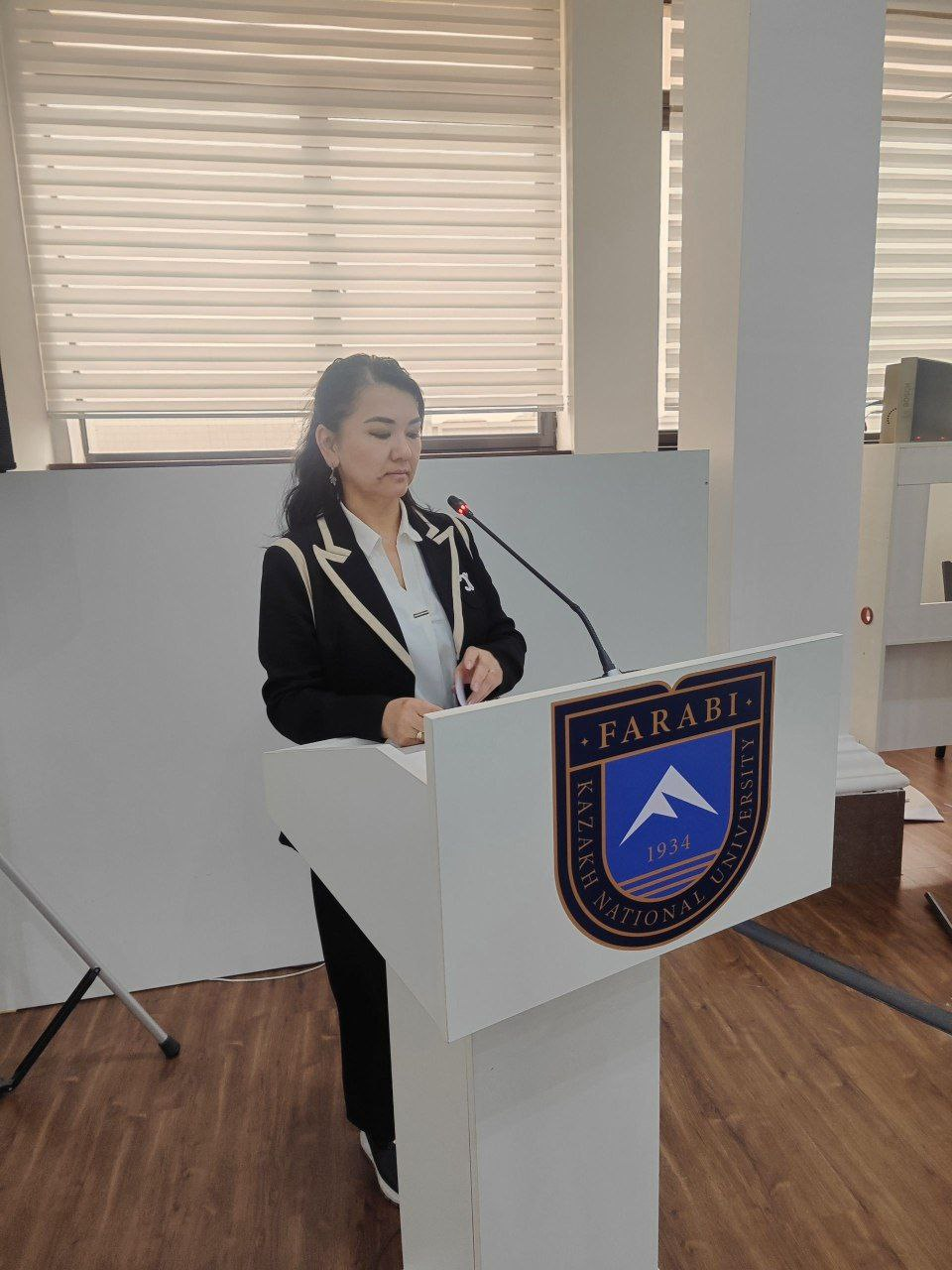
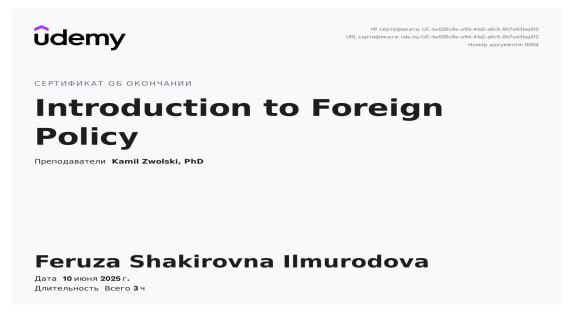
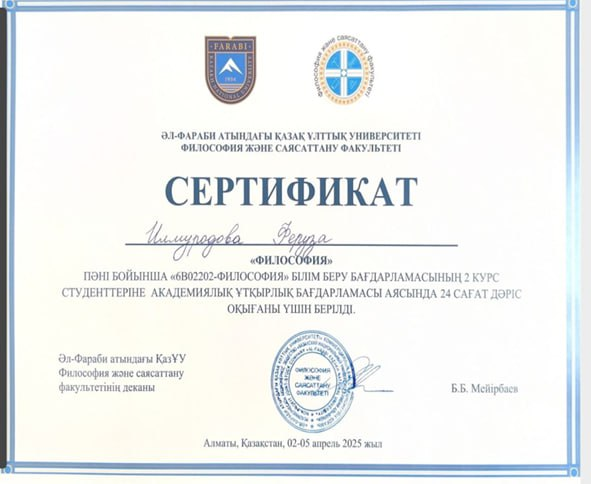
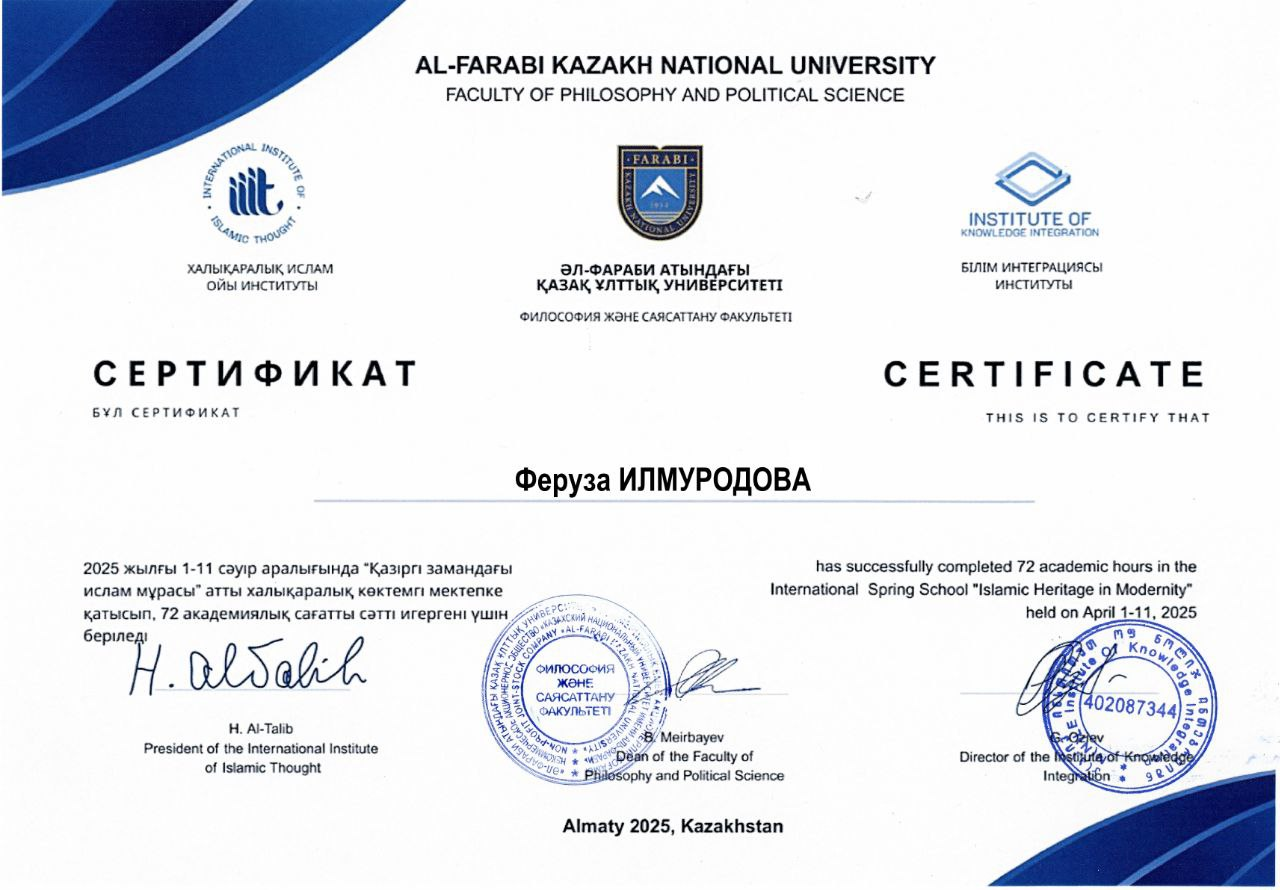
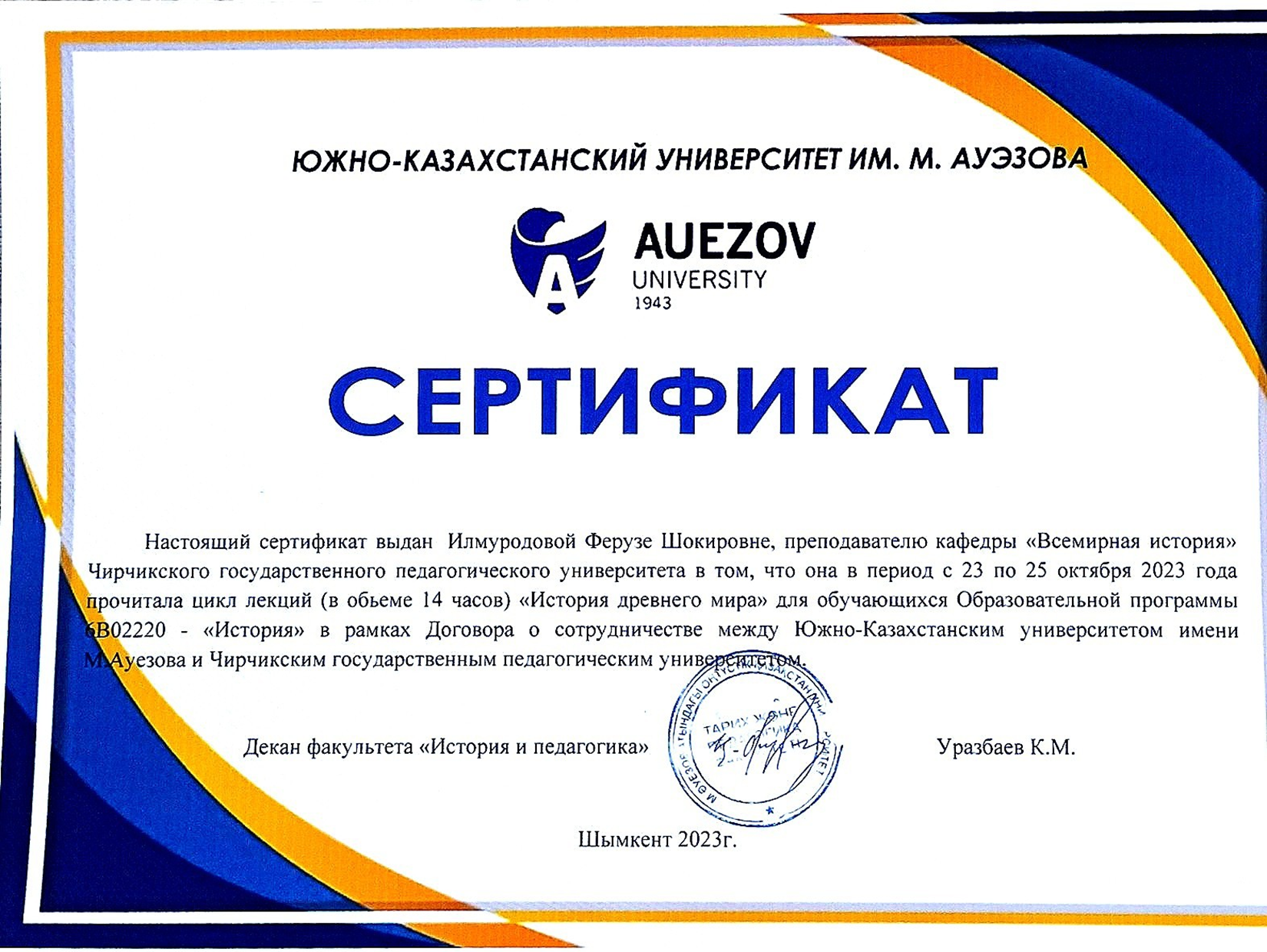
Ilmurodova Feruza Shakirovna, a graduate of Chirchik State Pedagogical University, was born on January 30, 1982 in the city of Samarkand, Samarkand region of the Republic of Uzbekistan. Department of Social Sciences, Faculty of Humanities, Chernivtsi State Pedagogical University. In 2000-2004, Nizomiy Nomi graduated from the History Department of Tashkent State Pedagogical University (Bachelor's degree), and in 2004-2006, Nizomiy Nomi graduated from Tashkent State Pedagogical University (Master's degree). 2006 - 2015 Tashkent Geodetic and Cartographic College history of Fani ukituvchisi, 2015-2017. Mirzo Ulugbek tumani 275th mektabda MMIB Director, 2017-2022. Mirzo Ulugbek tumani 275th mektabda Tarikh Fani ukituvchisi, 2022-2023. 2022-2023. Department of History and Teaching Methods Faculty of Humanities Chirchik State Pedagogical University, Since 2024, the Department of Social Sciences of the Faculty of Humanities of Chirchik State Pedagogical University will operate on the basis of the Department of Historical Sciences. More than 40 scientific papers have been published on the topic of the dissertation, including 10 scientific articles in national and 5 foreign journals submitted for the degree of Doctor of Historical Sciences by the Higher Attestation Commission of the Republic of Uzbekistan. The research results have been presented at 10 international conferences, 5 international and 5 international conferences.
All necessary documents for the degree of Candidate of Sciences, copies of diplomas, personal data, confirmation of the thesis topic, copies of the UAC bulletin, documents for the degree of Doctor of Philosophy exotic animals. Received the degree of Doctor of Philosophy in the specialty 13.00.02 – theory and methodology of teaching and upbringing: Foreign language (English): 62 points Expertise: 78 points. Honorary degrees are awarded by the President of the Republic of Uzbekistan in accordance with the Law of the Republic of Uzbekistan "On State Awards of the Republic of Uzbekistan". Scientific degrees are awarded to scientists who have completed an internship at the scientific seminar at the Institute of Oriental Studies of the Russian Academy of Sciences, in which the scientific seminar accepts dissertations for the degree of Doctor of Historical Sciences, as well as for the degree of Doctor of Historical Sciences. 3 nafar farandi bor.
Islamic philosophy has played a pivotal role in shaping the intellectual and scientific heritage of world civilization. Its criteria for scientific activity extend beyond mere empirical verification, encompassing spiritual, moral, and ethical dimensions. From a phenomenological perspective, knowledge in Islamic thought emerges as a dynamic interaction between human consciousness and divine revelation, reflecting an integrated approach to understanding reality. This perspective emphasizes that scientific inquiry in the Islamic tradition is inseparable from ethical responsibility and spiritual awareness, providing a holistic framework for intellectual development.
Historically, Islamic philosophers and scholars synthesized Greek, Indian, and Persian philosophical traditions, creating a unique epistemological system that combined rational inquiry with metaphysical and ethical reflection. This synthesis facilitated the advancement of natural sciences, mathematics, medicine, and social sciences in the medieval Islamic world, while simultaneously shaping a distinct intellectual culture that valued moral and spiritual insight alongside empirical investigation. The integration of diverse philosophical legacies enabled Islamic thought to serve as a bridge between ancient traditions and the emerging modern intellectual frameworks.
The present study aims to examine the cognitive, ethical, and methodological foundations of scientific knowledge in Islamic philosophy, employing a comparative-historical and phenomenological approach. By analyzing the interplay between reason, morality, and spiritual consciousness, this research seeks to provide a nuanced understanding of the mechanisms through which Islamic intellectual culture contributed to the global history of science and thought, highlighting its enduring relevance for contemporary philosophical and scientific discourse.
My scientific and strategic goal is to create an effective educational model and methodological system that serves to prepare future history teachers as a competitive professional, methodical and digital competencies, with a developed critical and historical thinking, loyal to national and universal values, based on national educational policy, international educational standards and modern pedagogical innovations, to introduce it into practice.
2000–2004 — Student at Tashkent State Pedagogical University named after Nizami
2004–2006 — Master’s Degree Student at Tashkent State Pedagogical University named after Nizami
2006–2015 — History Teacher at Tashkent College of Geodesy and Cartography
2015–2017 — Deputy Director for Spiritual and Educational Affairs at School No. 275, Mirzo Ulugbek District
2017–2022 — History Teacher at School No. 275, Mirzo Ulugbek District
2022–2023 — History Teacher, Department of World History, Faculty of Humanities, Chirchik State Pedagogical University
2022–2023 — History Teacher, Department of General History and Teaching Methodology, Faculty of Humanities, Chirchik State Pedagogical University
2024–2025 — Senior Lecturer in History, Department of Interfaculty Social Sciences, Faculty of Humanities, Chirchik State Pedagogical University
2026–Present — PhD in Pedagogical Sciences, Department of Interfaculty Social Sciences, Faculty of Humanities, Chirchik State Pedagogical University
Recommended Research Topics for Master’s Students
The following topics are designed for master’s students specializing in History. They cover the history of Uzbekistan, World History, historiography, source studies, digital history, and History Education.
I. HISTORY OF UZBEKISTAN
The Formation and Development of Early Statehood in the Territory of Uzbekistan
The Political and Socio-Economic History of Ancient Bactria
Ancient Khorezm: Statehood Traditions and Cultural Development
The Political and Cultural History of Ancient Sogdiana
The Kushan Empire and Its Role in the Development of Central Asian Civilization
The Role of the Silk Road in the Economic and Cultural Development of Central Asia
The Political and Diplomatic Relations of Central Asia during the Turkic Khaganate
The Political and Cultural Development of Transoxiana during the Samanid Period
State Administration and Socio-Economic Relations under the Karakhanids
The Rise and Fall of the Khwarazmian Empire
The Mongol Invasion and Its Impact on the Socio-Economic Development of Transoxiana
Amir Temur’s State Administration and Diplomatic Relations
International Trade and Cultural Relations during the Timurid Period
The Development of Science and Education under the Timurids
The Scientific Legacy of Mirzo Ulugbek and Its Contribution to World Science
Political and Cultural Development of Transoxiana under the Shaybanids
The Political History of the Bukhara Khanate during the Ashtarkhanid Period
The Foreign Policy and Diplomatic Relations of the Emirate of Bukhara
The Socio-Economic Development of the Khiva Khanate
The Political History and International Relations of the Kokand Khanate
II. THE JADID MOVEMENT AND NATIONAL AWAKENING
The Formation and Development of the Jadid Movement in Turkestan
The Jadids’ Views on National Statehood and Political Independence
Mahmudkhoja Behbudi’s Educational and Political Activities and Historical Legacy
Munavvar Qori Abdurashidkhanov and the Development of National Education
Abdulla Avloni’s Educational Ideas and His Role in the Jadid Movement
Abdurauf Fitrat’s Socio-Political Views and His Contribution to National Awakening
National Identity and Statehood in the Jadid Press of Turkestan
The Jadids’ Educational Reforms and the Development of New-Method Schools
The Turkestan Autonomy in Contemporary Historiography
The Influence of the Jadid Movement on the Development of Uzbek National Statehood
Archival Documents and Periodicals as Sources for Studying the Jadid Movement
International Relations of the Turkestan Jadids and Their Use of Foreign Educational Experience
The Socio-Cultural Foundations and Educational Programs of the Jadid Movement
The Formation of the National Intelligentsia in Turkestan in the Early Twentieth Century
Contemporary Historiography of the Jadid Movement: Approaches and Research Challenges
III. TURKESTAN UNDER THE RUSSIAN EMPIRE
The Russian Empire’s Conquest of Central Asia and Its Historical Consequences
The Turkestan Governor-Generalship: Administrative Structure and Colonial Governance
Russian Imperial Economic Policy in Turkestan and Its Social Consequences
National Liberation Movements in Turkestan: Causes, Development, and Historical Significance
The Andijan Uprising of 1898: Historical Sources and Contemporary Interpretations
The Turkestan Uprising of 1916: Causes, Development, and Consequences
Educational Transformation in Turkestan under Russian Imperial Rule
The Turkestan Press and the Formation of Public Opinion during the Colonial Period
The Significance of Russian Imperial Archival Documents for the Study of Turkestan’s History
Socio-Economic Relations in Turkestan in the Late Nineteenth and Early Twentieth Centuries
IV. UZBEKISTAN DURING THE SOVIET PERIOD
The Establishment of Soviet Power in Uzbekistan and Its Impact on National Statehood
National-Territorial Delimitation in Central Asia and Its Historical Consequences
Political Repression in Uzbekistan during the 1930s and the Fate of the National Intelligentsia
Research Challenges in Studying the Intellectual and Cultural Legacy of Repression Victims
Uzbekistan’s Contribution to the Home Front during the Second World War
The History of Evacuated Children and Civilians in Uzbekistan during the Second World War
The Establishment of Cotton Monoculture in Uzbekistan and Its Consequences
The Aral Sea Crisis: Historical Causes and Socio-Economic Consequences
Soviet Educational Policy and the Training of National Personnel in Uzbekistan
The “Cotton Affair” and Its Impact on Uzbekistan’s Socio-Political Life
Uzbekistan’s Soviet History in Local and Foreign Historiography
Socio-Political Processes and National Identity in Uzbekistan during the 1980s
Political Developments on the Eve of Uzbekistan’s Independence
Cultural Heritage Preservation in Uzbekistan during the Soviet Period
Soviet-Era Archival Documents as Sources for Studying Uzbekistan’s History
V. CONTEMPORARY HISTORY OF INDEPENDENT UZBEKISTAN
Uzbekistan’s Independence: The Process of Achievement and Its Historical Significance
The Formation of National State Institutions in Independent Uzbekistan
Constitutional Development and Public Administration Reforms in Uzbekistan
The Formation and Development of Uzbekistan’s Foreign Policy after Independence
The Historical Development of Relations between Uzbekistan and Other Central Asian States
Historical Memory and National Identity in Independent Uzbekistan
The Restoration of Historical Monuments and the Preservation of Cultural Heritage in Uzbekistan
The Historical Stages of Educational Reform in Independent Uzbekistan
The Historical Significance of Spiritual and Educational Reforms in New Uzbekistan
Uzbekistan’s Cooperation with International Organizations: Historical Experience and Development Prospects
The Formation of Civil Society Institutions in Independent Uzbekistan
The Development of Youth Policy in Uzbekistan
The Development Strategy of New Uzbekistan: Historical Background and Priority Areas
The Revival of National Values and the Promotion of Historical Heritage in Uzbekistan
The Development of Uzbek Historiography since Independence: New Methodological Approaches
VI. WORLD HISTORY
State Administration and Legal Relations in Ancient Eastern Civilizations
The Formation of Political Institutions in Ancient Greece and Rome
The Impact of the Age of Discovery on Global Trade and International Relations
The Reformation and Its Political Consequences in Europe
The French Revolution and Its Influence on European Political Thought
German Unification in the Nineteenth Century and European International Relations
The Causes and Geopolitical Consequences of the First World War
The Transformation of International Relations during the Second World War
The Geopolitical Strategies of the United States and the Soviet Union during the Cold War
The Collapse of Colonialism and the Independence of Asian and African States
China’s Political and Economic Modernization in the Second Half of the Twentieth Century
The Historical Stages of European Integration and the Formation of the European Union
Political and Social Modernization in the Republic of Turkey during the Twentieth Century
Iran’s Political Development and Revolutionary Transformations in the Twentieth Century
International Relations of Central Asian States after Independence
VII. HISTORIOGRAPHY AND HISTORICAL SOURCE STUDIES
The Scholarly Significance of Medieval Written Sources for the Study of Uzbekistan’s History
Baburnama as a Historical Source on Central Asia and India in the Early Sixteenth Century
Sharaf al-Din Ali Yazdi’s Zafarnama and the Historiography of the Timurid Period
The Source-Critical Characteristics of Narshakhi’s History of Bukhara
Waqf Documents as Historical Sources for the Study of Uzbekistan
Russian Imperial Archival Documents on Turkestan: A Source-Critical Analysis
Jadid Press Materials and Their Significance for Studying Early Twentieth-Century Socio-Political History
National Statehood in Uzbek Historiography since Independence
The Use of Epigraphic and Numismatic Sources in the Study of Uzbekistan’s History
The Digitization of Historical Sources and Its Potential for Historical Research
VIII. DIGITAL HISTORY AND INNOVATIVE RESEARCH
Digital History Methods in the Study of Uzbekistan’s Past
Geographic Information Systems (GIS) in Historical Research: Methodology and Applications
Digitizing Historical Maps of Central Asia and Advancing Historical Geography
The Digitization of Historical Sources and Its Significance for Historiography and Source Studies
Developing and Using Digital Databases on the History of Uzbekistan
Three-Dimensional Modeling and Virtual Reconstruction of Historical Monuments
Artificial Intelligence in Historical Research: Opportunities, Limitations, and Methodological Challenges
Methods of Studying Uzbekistan’s History through Digital Archives
Preserving and Promoting Historical Heritage in the Digital Environment
New Approaches to the Study of Uzbekistan’s History within the Digital Humanities
IX. HISTORY EDUCATION AND TEACHING METHODOLOGY
Improving the Methodology of Teaching History in General Secondary Schools
Pedagogical and Methodological Foundations of Digital Technology Integration in History Education
Developing Students’ Research Competencies through Historical Source Analysis
The Effectiveness of Problem-Based Learning in History Education
Improving Project-Based Learning Methodology in History Teaching
The Use of Virtual Museums and Digital Exhibitions in History Education
Developing Critical Thinking Skills through History Teaching
The Didactic Potential of Artificial Intelligence in History Education
Methods for Developing the Professional Competencies of Future History Teachers
Preparing Future History Teachers for Professional Practice through a Pedagogical Education Cluster
Interdisciplinary Integration in History Education: Methods and Applications
Developing Historical Thinking and Chronological Competencies in History Lessons
Pedagogical Conditions for Using Gamification in History Education
Methods for Developing the Digital Competencies of History Teachers
Technologies for Organizing Independent Learning and Research Activities in History Education