Normatov Otabek Maxamatjonovich — Professional Experience
PROFESSIONAL EXPERIENCE
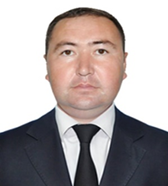
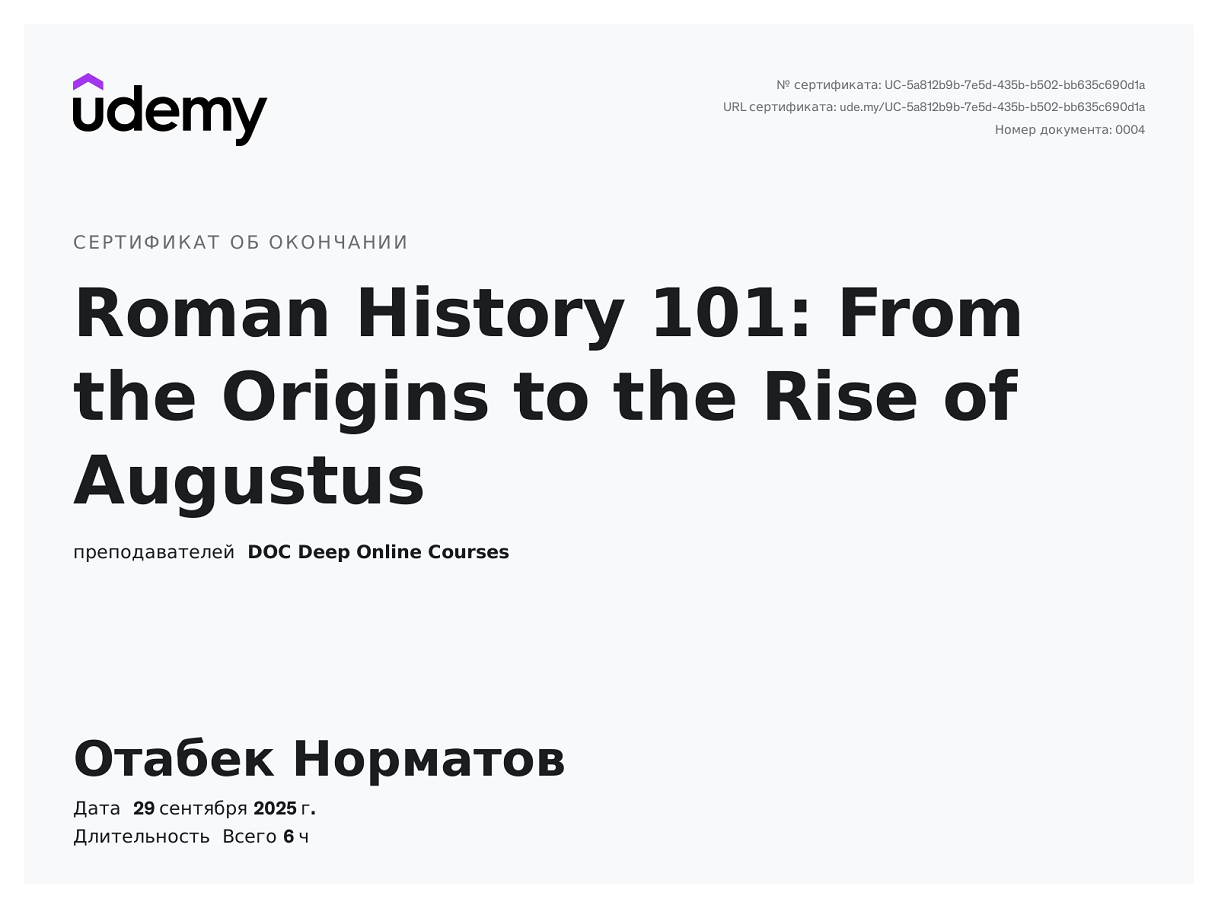
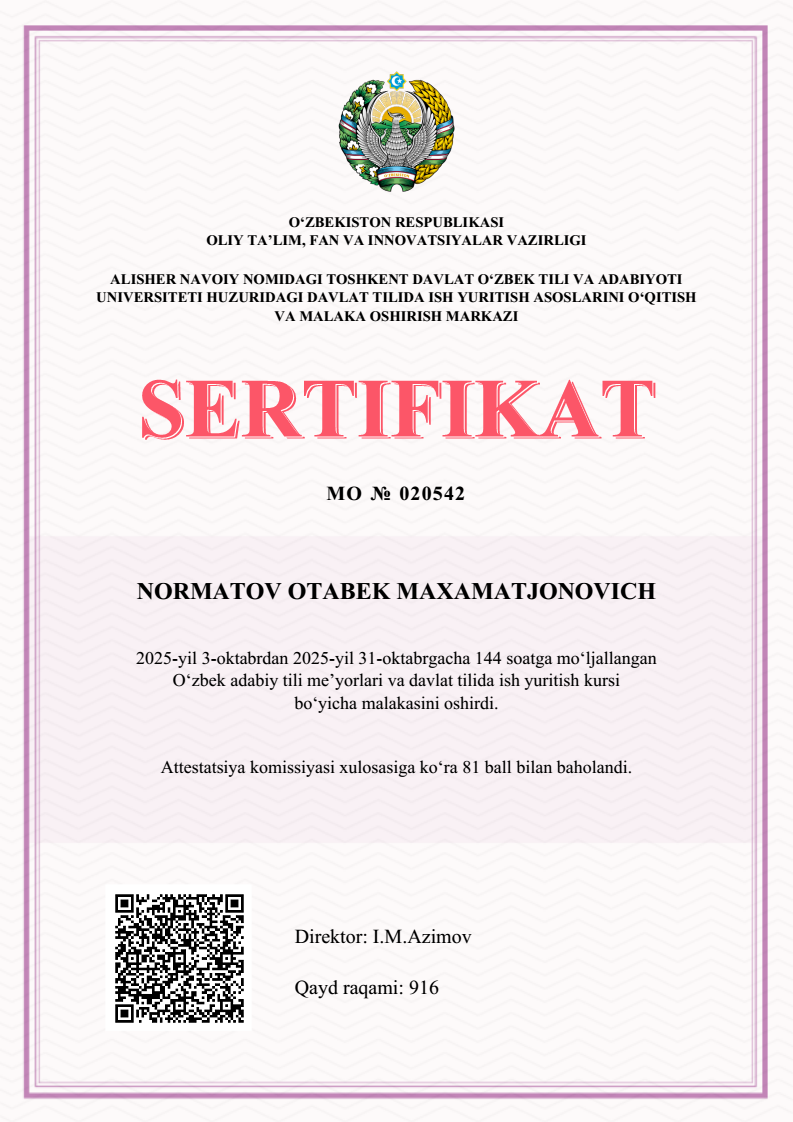
Normatov Otabek Maxamatjonovich
Chronology of education, teaching activity and professional
experience in educational institutions.
28+Years of professional activity
2Stages of education
4+Academic positions
2025Current position
1997–2002
Tashkent Regional State Pedagogical Institute
Student.
Education
2002–2004
Tashkent State Pedagogical University
named after Nizami
Student.
Education
2003–2006
Secondary School No. 216,
Hamza District, Tashkent
Teacher.
Secondary education
2006–2013
Tashkent Institute of Irrigation and Melioration
Assistant at the Department of Humanities.
Higher education
2014–2017
Tashkent Institute of Irrigation and Melioration
Senior Lecturer at the Department of Humanities.
2017–2021
Tashkent Institute of Irrigation and Agricultural
Mechanization Engineers
Senior Lecturer at the Department of Humanities.
2021–2022
Chirchiq State Pedagogical Institute
of Tashkent Region
Acting Associate Professor at the Department of History,
Faculty of Humanities.
2022–2023
Chirchiq State Pedagogical University
Head of the Department of World History,
Faculty of Humanities.
2023–2024
Chirchiq State Pedagogical University
Associate Professor at the Department of History of Uzbekistan,
Faculty of Humanities.
2024–2025
Chirchiq State Pedagogical University
Head of the Department of History,
Faculty of Humanities.
2025 – present
Chirchiq State Pedagogical University
Associate Professor at the Department of History,
Faculty of Humanities.
Current position
No matching information was found.
Head of the Department of history, dotseaHead of the Department of history, dots. t.f.f.d. Normatov Otabek Makhamatjonovich tervyusi of the TV channel History of Uzbekistan about the Republican scientific and practical conference on "modet Oasis"
Recommended topics for Bachelor's Qualification Papers,
Master's Theses, and Doctor of Philosophy (PhD) dissertations
in the field of History of Uzbekistan.
46
Total research topics
20
Bachelor's thesis topics
20
Master's thesis topics
6
PhD dissertation topics
PhD Dissertation Topics
Recommended topics for Doctor of Philosophy (PhD)
dissertations in historical sciences
6 topics
01
The history of legal relations between the local population
of Turkestan and the colonial administration
(1867–1917).
02
Everyday life of the rural population of Uzbekistan and
informal social relations during the Soviet period
(1946–1985).
03
The history of local-level management of water resource
use in Uzbekistan (1920–1991).
04
Women's informal economic activity in Uzbekistan and
their role in the formation of household income
(1950–1991).
05
The mahalla institution in everyday governance and
social protection mechanisms in Uzbekistan
(1960–1991).
06
The development of medical services in rural Uzbekistan
and the medical practices of the local population
(1946–1991).
Master's Thesis Topics
Recommended topics for Master's theses
20 topics
Specialization:
Methodology of Teaching Social Sciences and Humanities (History)
01
Methodology for teaching the formation and development
of the Jadid movement in Turkestan (1900–1920).
02
Methodology for studying Mahmudkhodja Behbudiy's
socio-political views and ideas of national development
in history education (1900–1919).
03
Methodology for teaching the formation of the national
press in Turkestan and its influence on public opinion
based on historical sources (1906–1917).
04
Methodology for teaching the causes, development and
historical consequences of the 1916 uprising in Turkestan
through problem-based learning technologies.
05
Methodology for teaching the revolutionary events of 1917
and national-democratic movements in Turkestan through
comparative historical analysis.
06
Methodology for teaching the establishment, activities
and dissolution of the Turkestan Autonomy based on
historical sources (1917–1918).
07
Methodology for teaching the establishment of the
Bukhara People's Soviet Republic and its socio-political
reforms through problem-based learning (1920–1924).
08
Methodology for teaching the establishment of Soviet
power in Turkestan and the attitude of the local
population based on historical documents
(1917–1924).
09
Methodology for teaching the policy of national-territorial
delimitation and the establishment of the Uzbek SSR
through interactive teaching methods (1924–1925).
10
Methodology for teaching the policy of dekulakization
in Uzbekistan and its impact on rural life using
historical sources and case-study technology
(1929–1933).
11
Methodology for teaching the political repressions of
the 1930s in Uzbekistan and the fate of national
intellectuals based on historical memory and source
analysis (1937–1938).
12
Methodology for teaching Uzbekistan's participation
in mobilization for the front and victory during
the Second World War through a competency-based
approach (1941–1945).
13
Methodology for teaching the process of Sovietization
in Uzbekistan and changes in traditional social relations
through a comparative historical approach (1920–1930).
14
Methodology for teaching collectivization policy
in Uzbekistan and changes in agriculture using
problem-based learning and historical source analysis
(1929–1941).
15
Methodology for teaching the formation of cotton
monoculture in Uzbekistan and its socio-economic
consequences through interdisciplinary integration
(1950–1980).
16
Methodology for teaching the origins of the Aral Sea
problem and its environmental and social consequences
through integrative learning (1960–1991).
17
Methodology for teaching the formation and development
of the Soviet education system in Uzbekistan using
a historical-comparative approach (1924–1941).
18
Methodology for teaching the social status of women
and their participation in public life in Soviet
Uzbekistan through a gender-based approach
(1920–1980).
19
Methodology for teaching the development of national
identity and attitudes toward national-cultural heritage
in Uzbekistan through historical sources and critical
thinking technologies (1985–1991).
20
Methodology for teaching the formation of the idea
of independence and the development of national-political
movements in Uzbekistan through problem-based learning
and comparative historical analysis (1985–1991).
Bachelor's Qualification Paper Topics
Recommended research topics for undergraduate students
20 topics
01
The formation of the national intelligentsia in Turkestan
and its role in the socio-cultural life of society
(1900–1917).
02
The activities of traditional schools and madrasas
in Turkestan: educational content and the issue of
reforms (1900–1917).
03
The development of handicrafts and domestic trade
relations in Turkestan (1900–1917).
04
Social life and changes in urban infrastructure
in the cities of Turkestan (1900–1917).
05
The activities of Russian-native schools in Turkestan
and the characteristics of colonial educational policy
(1900–1917).
06
The activities of national political organizations
in Turkestan and their social support base
(1917–1924).
07
Traditions of national statehood in Turkestan and
changes in the system of local governance
(1917–1924).
08
Armed resistance movements in Turkestan: regional
characteristics and relations with the local population
(1918–1924).
09
Public administration and socio-economic transformations
in the Khorezm People's Soviet Republic
(1920–1924).
10
The transition to a new alphabet in Uzbekistan and
its impact on education and cultural life
(1926–1940).
11
The formation and development of theatrical arts
in Uzbekistan during the Soviet period
(1920–1941).
12
Issues of preserving historical and cultural monuments
in Uzbekistan (1924–1941).
13
The establishment of industrial enterprises and
the formation of the working class in Uzbekistan
(1925–1941).
14
The formation of the healthcare system and medical
services for the population in Soviet Uzbekistan
(1924–1941).
15
The resettlement of evacuated populations and enterprises
in Uzbekistan during the Second World War
(1941–1945).
16
Living standards and everyday life of the population
in Uzbekistan during the post-war years
(1945–1955).
17
The development of scientific institutions and
the training of research personnel in Uzbekistan
(1945–1985).
18
The development of cinema in Uzbekistan and its role
in the spiritual life of society (1950–1985).
19
Socio-economic problems and the growth of public
activism in Uzbekistan during the period of
Perestroika (1985–1991).
20
The formation of national-cultural associations,
public organizations, and civic initiatives
in Uzbekistan (1985–1991).