Author: Doniyor Ibadullayev — PhD in Pedagogical Sciences, Senior Lecturer, Department of Information Technologies and Artificial Intelligence, Chirchiq State Pedagogical University.
Keywords: generative artificial intelligence, lesson plan, test generation, grading rubric, digital pedagogy.
Introduction: what is the problem?
Teachers spend a large share of their working time preparing for lessons: writing lesson plans, composing test questions and designing criteria to grade essays and written work fairly. This work matters, but much of it is repetitive. Generative artificial intelligence (AI) can speed it up, yet using general-purpose chatbots effectively requires prompt-writing skills, which remains an extra barrier for many teachers.
TeachAI HUB was built to remove that barrier: instead of writing complex prompts, the teacher fills in a few fields of a ready-made form, and the platform returns a result organised in a pedagogically meaningful structure.
About the platform
TeachAI HUB is a web platform designed specifically for teaching staff. It was created by lecturers of the Department of Information Technologies and Artificial Intelligence at Chirchiq State Pedagogical University and consists of three main modules.
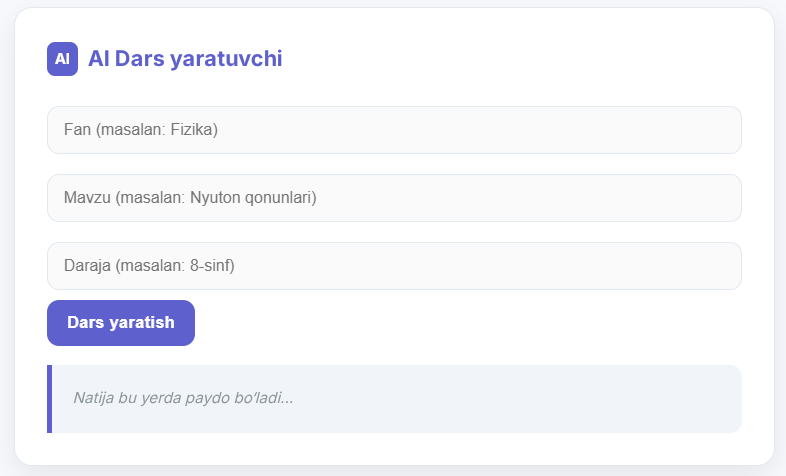
1. AI lesson builder
The teacher selects the subject, the topic and the grade or course. The platform drafts a lesson plan adapted to that level.
Example: a computer science teacher selects the topic “Loops in Python” for Grade 9. Within seconds a draft lesson plan is ready, which the teacher then adjusts to the class level and available equipment.
2. AI test builder
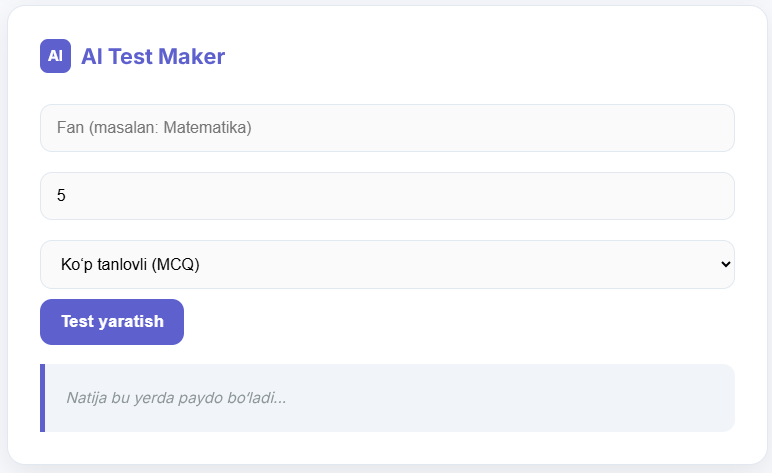
This module creates three types of tasks for pupils and students: multiple-answer, open-ended and multiple-choice tests. The teacher only enters the subject, the topic, the number of questions and the test type.
Example: for ten multiple-choice questions on “Symmetric encryption” in the course Fundamentals of Information Security, the teacher enters these three parameters, reviews the generated questions and edits them where needed.
3. AI grading rubric
A grading rubric is a table of assessment criteria, quality levels for each criterion and the corresponding points. Rubrics make assessment transparent: students know in advance what earns points and what to improve.
The teacher enters the task type (test, written work, question-and-answer or essay) and its content, and the platform proposes a suitable draft rubric.

Pedagogical principles
- The teacher stays in charge. Everything the platform produces is a draft. The teacher makes the final decision: checks the content, corrects errors and adapts it to the class.
- Fact-checking. Generative AI can produce inaccurate or wrong information, so answer keys and lesson content must always be checked.
- Data privacy. No personal data of pupils is entered into the platform.
- A human-centred approach. These principles are consistent with UNESCO’s “Guidance for generative AI in education and research” published in 2023.
Current status and development plans
At present TeachAI HUB returns results as text. In the next stage, an online link to the platform will be published and the option to download generated materials in PDF, Word and PowerPoint formats will be added.
Conclusion
TeachAI HUB does not replace the teacher. It reduces routine work so that teachers can devote more time to lesson quality, individual work with learners and creative methods. Stay tuned for updates on the platform.