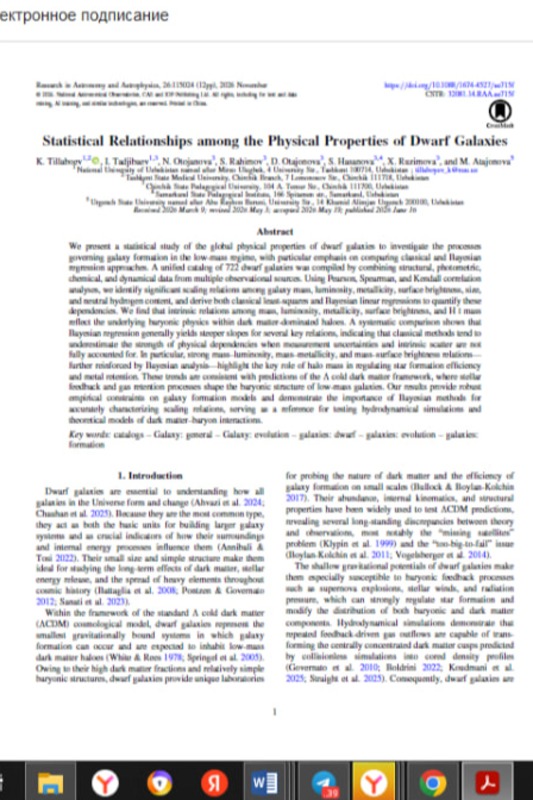
Statistical Relationships among the Physical Properties of Dwarf Galaxies
QR kod:
Yuklab olishlar
We present a statistical study of the global physical properties of dwarf galaxies to investigate the processes
governing galaxy formation in the low-mass regime, with particular emphasis on comparing classical and Bayesian
regression approaches. A unified catalog of 722 dwarf galaxies was compiled by combining structural, photometric,
chemical, and dynamical data from multiple observational sources. Using Pearson, Spearman, and Kendall correlation
analyses, we identify significant scaling relations among galaxy mass, luminosity, metallicity, surface brightness, size,
and neutral hydrogen content, and derive both classical least-squares and Bayesian linear regressions to quantify these
dependencies. We find that intrinsic relations among mass, luminosity, metallicity, surface brightness, and H I mass
reflect the underlying baryonic physics within dark matter-dominated haloes. A systematic comparison shows that
Bayesian regression generally yields steeper slopes for several key relations, indicating that classical methods tend to
underestimate the strength of physical dependencies when measurement uncertainties and intrinsic scatter are not
fully accounted for. In particular, strong mass–luminosity, mass–metallicity, and mass–surface brightness relations—
further reinforced by Bayesian analysis—highlight the key role of halo mass in regulating star formation efficiency
and metal retention. These trends are consistent with predictions of the Λ cold dark matter framework, where stellar
feedback and gas retention processes shape the baryonic structure of low-mass galaxies. Our results provide robust
empirical constraints on galaxy formation models and demonstrate the importance of Bayesian methods for
accurately characterizing scaling relations, serving as a reference for testing hydrodynamical simulations and
theoretical models of dark matter–baryon interactions.